


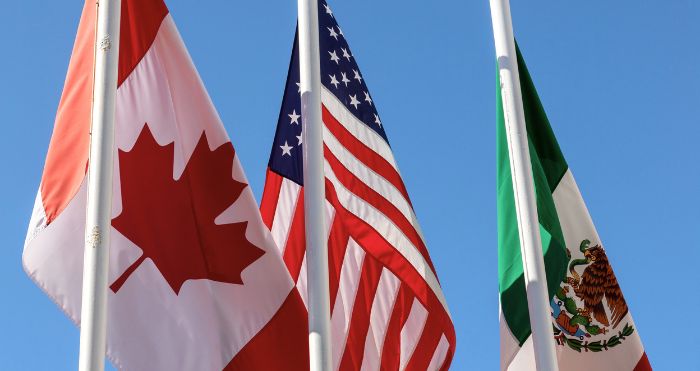
Is This The End of USMCA?
On July 1, 2026, the US Government declined to renew its trade agreement, in its current form, with Canada and Mexico, or, as it's better known, the ‘Canada-US-Mexico Agreement’ (CUSMA/USMCA/T-MEC).
With increasingly complicated relations between the member nations, a near constant in the news cycle over the past year, and the bolstering of barriers to international trade remaining high on the political agenda, the truth is that, for those in the know, this outcome has been likely for months.
But now, with the decision made and the next phase of free trade in North America just beginning to unfold, international businesses of all shapes and sizes face a complicated question: what does this mean, and, perhaps more importantly, what could possibly come next?
CUSMA 101
CUSMA/USMCA/T-MEC (or as we’re going to refer to it for the duration of this post, ‘CUSMA’) has always been an evolving concept in North American international trade. The current version is an advancement of the North American Free Trade Agreement (NAFTA), which was signed into law in 1994 and remained in effect until CUSMA came into force on July 1, 2020.
The agreement itself has a baked-in 16-year lifespan, which puts its expiration date at July 1, 2036. However, the agreement features what is referred to as the “Sunset Clause.” This clause calls for a mandatory joint review from the participating countries every six years. During these reviews, the countries get to decide if they wish to ‘formally extend’ the agreement for another 16 years.
The conceit here is that everyone involved must be happy with the current arrangement, and at several fixed points in the agreement's lifespan, countries have access to a proverbial rip cord to get them out of it, which, on July 1st, the US Government elected to pull.
Importantly, there is no such thing as a quick exit from a free trade agreement (FTA) like CUSMA, and electing not to renew is not the same as leaving it entirely, although choosing not to renew does come with its own set of challenges for North American trade.
What Happened?
While the Canadian and Mexican governments, prior to the negotiation, both signaled an intention to resign, the US has continued to express dissatisfaction with CUSMA as an established agreement over the course of the past few years, with it even toeing the line of threatening to leave the agreement outright as late as a few weeks prior at the June 2026 G7 meeting. The US Government’s primary concerns have been publicly centered on trade deficits and the perceived “shortcomings” it witnessed in the deal as it stands now.
For this reason, very few seemed surprised by this outcome - including the leadership of the other two governments, who entered the preset negotiation, but held no real anticipation that it would yield a deal. However, despite this ultimately correct predetermination, there is a surprising level of optimism that pervades much of the discourse surrounding this. As Steve Verheul, one of the lead negotiators in the original CUSMA formation, was quoted as saying,
“We are looking at a very different kind of discussion than we had [previously]. At that point, we were trying to negotiate 34 chapters of an agreement, and that was a very different kind of scenario than we’re looking at now.”
Many experts indicate that it is significantly easier to spot-check an agreement and come to terms than to build one from the ground up. Which is good news, because with the extension being declined, spot-checking the agreement is exactly what the governments of North America are about to embark on over the next ten years.
What It Means, and What It Doesn’t
Before we go any further, here is a reassurance - this is not the end of CUSMA as we know it, at least not in the near future. It is, unless something dramatic happens, business as usual.
The agreement remains in effect until 2036, but with the extension declined, it has entered a yearly review cycle. This means that, from this point on, the three signing nations must meet annually, rather than the six previously established. From this point on, CUSMA is under review every year, with the opportunity to renegotiate any issues they have with the agreement firmly on the table.
One of the mercies is that even if the parties don’t agree to extend now, the option to join later remains a possibility, and the agreement still holds until 2036 regardless of the success of these annual discussions
As of this moment, duty-free privileges, tariff rate quotas, and current border procedures remain in place for importers, and even if a signing member decides to leave the agreement tomorrow, there is a requirement of six months' notice. Which means that even if CUSMA were to truly end, it would do so slowly and with plenty of warning.
Still, there are additional complications to consider, and things may not be so copacetic forever.
A Potentially Perilous Future For Free Trade in North America
The hard truth is that even though CUSMA remains intact, this isn’t necessarily good news for importers, as it signals instability that can disrupt trade in unpredictable and often negative ways.
Yearly negotiations might seem fine on paper, but in similar situations around the globe, they often become flashpoints of contention between nations and opportunities to leverage participation in the agreement for political capital.
Consider that one of these yearly reviews could very easily end with one or more parties not getting the outcome they are seeking. They may choose to instead take other paths to get the same outcome, such as levying new domestic regulations, such as tariffs and trade barriers in an effort to pressure for the changes that they are seeking. For example, we’re seeing nearly this exact thing happening with the Coupang Inc. situation in South Korea. While South Korea is in an agreement with the US, it is, allegedly, levying a campaign of investigations, audits, and other regulatory actions against US companies in a perceived effort to protect its own tech industry in a roundabout way.
While a country may not have the authority to impose tariffs because an agreement forbids it, it is still free to pursue domestic regulations, which can be ruinous for affected industries.
Add to that the looming Sword of Damocles that is each nation’s option to just leave the agreement at any time, and you have a mixture of instability in an arena that demands it. For example, while yearly reviews and a six-month wind-down if someone decides to leave can be plenty of time for some industries, businesses with long-term projections cannot reasonably predict the cost of importing goods even a year into the future, as the agreement they are basing their pricing on may not even exist.
This ‘zombie mode’, as some analysts call it, is what happens if no agreement can be reached. A lurching, destabilizing situation that is nothing less than a profoundly challenging place to be for North American businesses, and the sooner it is resolved, the better off everyone will be in the long run. However, if no resolution is found, it will run its course for 10 years, leaving North American trade in a precarious position of mounting uncertainty every step of the way.
What Should You Do Now?
There are a few things to consider, and now may be a good time to start looking ahead. For starters, if you haven’t already, now is the time to get your house in order in terms of meeting regulatory requirements. Working closely with a broker to make yourself as compliant and above board as possible is vital. Restrictions and audits could very easily be on the rise as a result of this uncertainty, and you need to be prepared for that. The days of easy crossing have been gone for a while, but there is plenty of tightening to be done if any of the affected governments choose to do so.
Next, if you haven’t yet, now is a good time to start thinking globally. The US, Canada, and Mexico all maintain a host of FTAs with many countries, and right now, North America is in a moment of flux. If you have ever contemplated exporting abroad, now could be a good time to start exploring your options and see whether different markets make sense for you.
Finally, now is the time to start working with a trade expert at the planning stage. The age of doing things yourself with grit and determination is behind us, and now is the time to begin investing in intellectual capital for your business.
How you navigate the currently choppy waters of the international marketplace could very easily dictate your success or failure, and having an expert navigator on board can make all the difference.
—
PCB can help with all of this. From working closely with you to make sure your business meets compliant benchmarks to assisting you with exporting your goods to the wider world, we have the specialized services and expertise you need now more than ever.
To find out how we can help you, we encourage you to peruse our Trade Advisory Services and see where we can help keep your goods moving. And, as always, if you are looking for the latest in trade news, like this, delivered right to your inbox, you are encouraged to sign up for our Trading Post newsletter.
With PCB on your side, the next 10 years could be growth and success in spite of any upheavals that could be unfolding in the world of trade.





%20Logo%20Vector-DBG.svg)