


Blog Articles

Customs and Border Protection (CBP) has recently updated its Trade Statistics page with new information about its financial realities over the past six years. This page covers information spanning the last six years - a set of years that has seen international trade enter the political and public discourse like never before. The revenue that CBP recovers can give us real insight into what’s happening in a very grounded and undeniable way, and is worthy of investigation.
Read MoreCustoms and Border Protection (CBP) has recently updated its Trade Statistics page with new information about its financial realities over the past six years. This page covers information spanning the last six years - a set of years that has seen international trade enter the political and public discourse like never before. The revenue that CBP recovers can give us real insight into what’s happening in a very grounded and undeniable way, and is worthy of investigation.
While the bulk of the page is dedicated to the financial realities of the new tariffs and section duties, one of the most significant data points is tucked into a chart at the bottom of the page. Namely, “Net Revenue Recovered due to Entry Summary Reviews (ESF)” or, as we like to think of it, the answer to the question of just how much CBP cares about trade compliance after a good has already been released.
What does this data actually mean for you as an importer? Well, we touched on the topic of post-summary corrections briefly earlier this year and also highlighted early indicators that audits were on the rise in May of last year, but now, it seems CBP is confirming what we were seeing at the brokerage level. This data also offers a clear view of CBP’s priorities. And, as always, if we know Customs’ priorities, we can prepare for them.
The Evaporating Illusion of ‘Cleared Customs’
It’s easy to feel a sense of relief once your goods cross through Customs. You’ve made your declarations, you believe your information is accurate, and surely, the hard part is over.
Unfortunately, that is simply not the case. As discussed in our dive into reconciliation, CBP operates on a longer schedule than one might imagine from the outside - they are verifying on the ground and then continuing that verification even after the goods have been released. Importers declare their goods, but CBP has up to a year after the fact to verify that declaration, and then they have up to five years after the fact to audit it.
We have other blogs that detail the audit process, but the point here is that it’s important to understand that ‘clearing Customs’ is a process in and of itself, and compliance at the border, while incredibly important, is more of a starting place than an ending. Your responsibilities as an importer extend beyond the wheels of a truck crossing a port of entry or a container entering into the commerce of the US. The key takeaway here is that CBP has up to a year for the initial assessment after release; under its Informed Compliance policy, it can continue to use post-release data to check tariff classifications and product valuations, issuing customs penalties even well after your goods are on the shelf.
We hear you; CBP is rigorous at the border, surely, this must be a fairly rare occurrence. As it turns out, no. In fact, entry summary reviews have never been a more profitable enterprise.
A Multi-Billion Dollar Wake-Up Call
Let’s look at the data and see what it’s telling us. The bullet point is that prior to 2025, CBP’s post-release recovery averaged around $250 million to $600 million annually, and in 2025, it ended its year at a staggering $34.4 billion - nearly 15% of the total revenue that CBP collected for the year. The exact reasons for this leap have not been officially identified, but there are a few obvious things we can point to as good guesses: renewed political interest in cross-border trade, including a new mandate for greater enforcement, the steady uptick in technological advancements, and a raft of new tariffs and trade regulations for importers to make errors on.
Regardless of why this has happened, what it clearly indicates is that something is shifting at Customs, and the consequence of that shift is that now post-release recovery has entered the spotlight as a primary means of collection like never before.
It should be noted that 2025 was, admittedly, an anomaly of scale, and as of July 2026, CBP’s post-release recovery has fallen significantly since then and is currently sitting at a modest $10 billion. Now, before you throw your hands up and ask why we’re pointing this out if the 2025 leap was a one-time thing, remember that $10 billion is still a 1566% increase from 2024 - just two years prior- and 2026 isn’t finished yet. 2025 was an anomaly, but it was also a herald of change - a watershed moment that we are not returning from any time soon.
Clearly, post-release recovery is a high priority for CBP, which makes sense - trade has become a magnitude more complicated over the past few years, and the mandate and technology to detect the inevitable errors are both on the rise.
Regardless of the reason, CBP is using this tool and is becoming effective at it like never before.
What Does This Mean for Importers?
To start, this clearly indicates that what we have been warning importers about for years has come to pass: audits and post-release reviews are on the rise, with common pitfalls including improper HTS product codes, inaccurate customs valuation, or mistakes in declaring the country of origin. Importers need to adapt or watch as they contribute to this year’s column of the Trade Statistics page.
For years, getting your goods across the border stood out as the primary challenge of importing, but today, CBP releases goods on what might best be considered a provisional trust.
The reality is that you need to be perfect at a time in trade history when it has never been more difficult to do so. Goods that used to flow through Customs easily are now being analyzed with even greater scrutiny. With greater enforcement and more complex trade, it is vital for your goods to pass inspection at Customs while also keeping your documentation correct and available above and beyond what will get you across the physical space.
More than ever before, a good effort and estimate on any of the major axes of importing is not enough - you need to know, and you need to be able to prove it, not just now, but up to five years after the fact. Which is made more complicated by the fact that it is literally more difficult to do it right. What was once one tariff code per good can now be upwards of five. It’s no longer ‘be more accurate,’ it’s a procedural change that for many businesses must be undertaken as soon as possible.
The hard truth is that in light of this information, importers are advised to start changing their thinking, updating their compliance checklists, and taking the long view on importing goods because those who don’t are, demonstrably, getting caught. If you don’t want that to be you, then now is the time to start working closely with a trade advisor to ensure that you are covered, not just now, but into the future.
—
Of course, you aren’t alone in this. PCB can help you take the necessary steps to not only have your goods cross easily, but also stand up to scrutiny after the fact.
We can also help you navigate this shifting landscape in a few key ways, including:
- Helping you determine what you need to do to prepare for audits and post-release corrections, including help identifying what documentation could be needed up to five years from now in a potential audit
- Assistance with post-summary corrections and prior disclosures
- And even support when going through the protest process, should it come to that
Trade is changing rapidly, but the Trade Advisory Team at PCB has our fingers on the pulse - and we are here to help make sure you are ready for what is happening now and what could happen in the not-so-distant future.

As the title might suggest, it is once again time to renew your free trade agreement (FTA) certifications, including your CUSMA/USMCA/T-MEC Certificate of Origin.
Read MoreAs the title might suggest, it is once again time to renew your free trade agreement (FTA) certifications, including your CUSMA/USMCA/T-MEC Certificate of Origin.
If you already know what we are talking about, then just consider this a friendly reminder to get your certification in order as you’ve done in the past. Complete information about filling out a certificate of origin can be found below. As always, when you are ready, you are encouraged to contact your broker to initiate this process, and you are encouraged to do it as promptly as possible. Sooner is always better than later in our current trade environment.
However, if you don’t know what an FTA like CUSMA/USMCA/T-MEC is, why it’s important to renew free trade agreement documents, or what documents you need to renew your FTA, then read on because in this week’s blog, we are going to cover all of it.
What is a Free Trade Agreement?
A free trade agreement is an understanding between nations to eliminate or significantly reduce tariffs and the trade barriers that exist between them.
Importers can take advantage of these agreements, which represent one of the best ways to save money at Customs. Under the auspices of these agreements, goods that are wholly from one of the relevant countries can be imported into another country with reduced or free duties. Canada maintains around 15 of these agreements internationally with over 50 countries, while the US has around 14 with 20, but for both countries, the most prolific is undeniably CUSMA/USMCA/T-MEC.
CUSMA/USMCA/T-MEC, for those unaware, is the myriad-named agreement between Mexico, Canada, and the US. Each country orders the letters of the acronym differently, but they are different names for the same thing, and each name can be used interchangeably. In this blog, we’re going to list all three.
Notably, the large majority of the tariff orders issued in the past few years have had exceptions within CUSMA/USMCA/T-MEC. So, it is incredibly important to review your goods' eligibility as qualification for this FTA could offer significant cost savings.
On the other hand, there are exceptions, and some trade actions, like the Section 338 tariffs, did not afford a duty reduction for goods eligible under CUSMA/USMCA/T-MEC, and still do not qualify. For those, it is important to lean on services like our comprehensive classification reviews, particularly if you have not yet had a deep dive on your classifications or if you have been using the same one for some time. Your situation may have changed under your feet, and the only way to know for sure is with a comprehensive review.
What is a Certificate of Origin?
A certificate or certification of origin is the document or required data elements that indicate your goods comply with the rules of origin laid out by the FTA you are attempting to qualify for.
An FTA’s rules of origin are the guidelines for how much production must occur in a specific country for the goods to be considered having ‘originated in,’ and therefore entitled to a specific tariff treatment.’ Not to be confused with where the goods are exported. This is concerned with where the goods are grown or produced and where the parts used in their manufacture come from. They are also concerned with whether the goods have remained outside the commerce of non-member countries.
A good example is plants or vegetables, which are almost always grown in a single country. Their origin is simple to determine; however, it becomes more complicated when considering how much of a highly manufactured good must be from a country for it to qualify under the relevant FTA’s rules of origin.
We have a blog post that covers the topic in more detail, and you are encouraged to read it as a companion to this post, but the key point is that the rules of origin differ from one FTA to another, and CUSMA/USMCA/T-MEC is no exception. Every year, you are expected to declare your goods as being compliant with the rules of origin laid out by the FTA you are seeking to qualify for. You then file the declaration with your customs broker and/or importer of record, who sends it to the relevant Customs authority.
In general, FTAs are a self-certifying process. This means that it is entirely up to the importer to declare what qualifies and what doesn’t. There are a few upshots to that, but the most notable one is that it makes FTA documentation a routine target for audits and verifications, and they can be targeted up to five years after the goods cross, depending on which side of the border your business resides. So, while it is self-certified, keep in mind that makes accuracy MORE important, and you are encouraged to work with your broker to ensure your goods are correctly defined before you submit the certification.
For certainty in your FTA declarations, you are encouraged to put our FTA Review and Ruling Services to work. We can write to the CBSA or CBP for FTA origin qualifications, and help ensure you are covered in the case of a verification or audit.
Important Note on Certification and Documentation
Ultimately, the certification process is entirely self-served and, in truth, is largely for the benefit of organizing your claims both for your own internal use and that of your broker. What is more important, beyond the certification itself, is how you prove your goods meet the necessary criteria. These elements can and will be audited/verified, and you are encouraged to be prepared.
Examples of some of the documents that could serve to prove your goods qualification include:
- Production or component purchasing invoices
- Supply chain records that demonstrate a link from procurement to purchase
- Labor, costing, and other production overhead records
- Any official documentation that shows where a material or good came from
Ensuring that you have the necessary documentation to prove the claims that you are making is vitally important. Not only can Customs audit certifications like any other element of an import, but they can take up to five years to do so.
How to Fill Out a Certification of Origin for CUSMA/USMCA/T-MEC?
CUSMA/USMCA/T-MEC certificates require annual renewal, and renewing this document essentially means recertifying with the same nine minimum required data elements you submitted in the CUSMA/USMCA/T-MEC Certification of Origin form. Like a new certification, you then provide the completed document to your broker.
The data elements are as follows:
- Certifier
This field is here to indicate who you are as the certifier. Are you an exporter, producer, or importer of the goods? It essentially informs the reviewer that the person filling out the document is relevant to the goods.
- Certifier Details
Here is where you list your contact information for Customs, including:
- Name
- Title within your company
- Company’s complete address
- Phone number
- Email address
- Exporter Details (if different from the certifier)
There are three possible outcomes for this field, depending on who you are in the process:
- Exporter and Certifier: If you are both the exporter and the certifier listed above, you can fill this area out again with your details. However, at a minimum, you need to include your company name, as it will be included above in field two.
- Producer: It is possible you don’t know the identity of the exporter, in which case the information here is not required and you may put “Unknown” in the field.
- Importer: You must complete this field entirely. Notably, the address of the exporter in this field should be the goods’ place of export and a residence within a North American country.
- Producer Details
Once again, there are three options for this section:
- Producer and Certifier: You may fill this out completely or, at the very least, include your company name, as you have listed the other information in field two.
- There are multiple producers: You are allowed to state ‘Various’ and then provide a list of those producers.
- The relevant party wishes to stay confidential: You are free to state ‘Available Upon Request,' if you are recertifying for USMCA, or ‘Available upon request by authorities’ if you are recertifying for CUSMA. But, in either case, understand that if this information is requested, you will be obligated to divulge it. The address of the producer in this field should be the goods’ place of production and, like above, should reside within a North American country.
You are also permitted to put ‘Unknown’ in this field, but be aware that it is a magnitude more difficult to certify goods if the producer of those goods is unknown.
- Importer Details
If you are the producer or the exporter and you know the importer’s details, this is the field to provide those details.
If there are multiple importers, you may state "Various" and provide a list of the importers upon request.
If you do not know the importer, simply state ‘Unknown’.
- HS Tariff Classification (6a) & Description of the Good and Invoice Number (6b)
In Section 6a, you must provide the HS tariff classification for these goods to the six-digit level as listed in the Customs Tariff. If you need assistance determining this code, please do not hesitate to contact your broker.
In Section 6b, you need to provide a description of the goods in simple and understandable terms (i.e., layman's terms). The description should be enough to easily identify the goods covered by this form.
Additionally, if this form covers a single shipment, please indicate the invoice number associated with the shipment. If it covers goods on multiple shipments and for which the invoice numbers are not yet known, or if you simply don’t know the invoice number, they can be excluded.
- Origin Criterion
In this section, you are indicating which of the origin criteria your goods fall under as set in Article 4.2 - Originating Goods of the rules of origin document.
You must select A, B, C, or D from the following:
- Wholly obtained or produced entirely in the territory of one or more of the Parties, as defined in Article 4.3 (Wholly Obtained or Produced Goods)
Essentially, this indicates that the good was made, grown, or produced entirely within North America. The best examples here are plants or vegetables.
- Produced entirely in the territory of one or more of the Parties using non-originating materials, provided the good satisfies all applicable requirements of Annex 4-B (Product-Specific Rules of Origin)
These are goods that are almost entirely made with components produced in North America, but include some parts from other countries. A notable example might be a bed frame made in Canada, entirely of Canadian lumber, but assembled with Chinese screws.
- Produced entirely in the territory of one or more of the Parties exclusively from originating materials
These are goods that are manufactured within North America and use North American components. If we expand on the bed frame example, it would be like if it were made with Canadian wood and American screws. The component parts are all still within the FTA’s jurisdiction.
- Narrow Cases
Criterion D applies when a good is produced entirely in the territory of one or more CUSMA/USMCA/T-MEC parties, is classified with its materials or satisfies the “unassembled goods” requirement, and meets the stated Regional Value Content threshold based on the method used.
You are encouraged to work closely with your broker to make sure your goods are identified by the correct criteria.
8. Period Covered by Certification (If Applicable)
If the certification covers multiple shipments of identical goods, this field is used to specify the date range for that period, which can be up to 12 months.
For example, a typical FTA document validity period is a year, from January 1 to December 31.
While it isn’t required, a question we are regularly asked is how to find free trade agreement expiry dates, and the answer is that you established it when you certified the goods. It is highly recommended that all blanket FTAs be dated for a standard calendar year. This is largely to ensure that importers can maintain consistent renewal dates year after year.
9. Certification
Finally, the certification must include the mandatory certification statement:
“I certify that the goods described in this document qualify as originating and the information contained in this document is true and accurate. I assume responsibility for proving such representations and agree to maintain and present upon request or to make available during a verification visit, documentation necessary to support this certification.”
Then have it signed and dated by the Certifier. Remember, by filling out this form, you are declaring that you believe the goods qualify under the rules of origin for CUSMA/USMCA/T-MEC. Once it is signed, you are done, and it’s time to submit it to your customs broker.
—
Like everything in international trade, working with a trade advisor or a skilled customs broker can be a significant advantage in the certification process and the management and maintenance of your records.
For more information about FTAs or assistance with your downloaded certificate of origin, be sure to get in touch with our Trade Advisory Service team today.
Whether you are renewing your certificates or doing this for the first time, we can help. From identifying and assisting you in your qualification for relevant FTAs to determining the country of origin for your goods and submitting the necessary paperwork for certification, our FTA Review Service is here to get you importing under an FTA quickly and easily.
With our help, this can be just another yearly task scratched off your list, so get in touch today!

As part of the Food Safety Modernization Act (FSMA), all US facilities that manufacture, process, pack, or hold food for human consumption must register with the US Food and Drug Administration (FDA) every two years. An easy way to remember is that re-registration opens during a specific window in every even-numbered year. Facilities are required to register and re-register in this way to help address food safety threats and provide a backbone for tracing food-borne issues.
Read MoreAs part of the Food Safety Modernization Act (FSMA), all US facilities that manufacture, process, pack, or hold food for human consumption must register with the US Food and Drug Administration (FDA) every two years. An easy way to remember is that re-registration opens during a specific window in every even-numbered year. Facilities are required to register and re-register in this way to help address food safety threats and provide a backbone for tracing food-borne issues.
If the current year ends in an even number (zero is even), the registration window opens on October 1 and closes on December 31. If you don’t know how to proceed with , you have come to the right place.
What is the Biennial Renewal Requirement?
Essentially, every business that needs to register or re-register must do so between October 1 and December 31 every even-numbered year.
Those businesses that are just beginning operations are legally required to register with the FDA before handling food that is destined for the US market. However, if you register in an odd year or outside the mandated date range, you will be required to renew the registration again at the next even-numbered October 1 - December 31 window.
Businesses that fail to re-register before December 31 will have their registration considered expired and will need to start the registration process again from the beginning.
Who Has to Register with the FDA?
All domestic and foreign facilities that manufacture, pack, or store food or food ingredients intended for the US market must register with the FDA. Domestic facilities proceed with the registration process as it is detailed below, but foreign facilities must designate a US agent to serve as their touchpoint with the FDA.
This agent must reside or maintain a place of business in the US, and will act as the primary point of contact for the FDA on behalf of the foreign company. You must have a US agent before you can attempt the registration/re-registration process.
How to Renew Your FDA Food Facility Registration/Re-Registration
The process is entirely free and handled through the FDA Industry Systems (FIS) portal. You will need to have a Unique Facility Identifier (UFI) when you register; at present, the FDA accepts the Data Universal Numbering System (DUNS) as an acceptable UFI. This number, if you don’t have it, is provided by Dun & Bradstreet.
Once you have the required number and, if applicable, a U.S. agent, you can complete the registration entirely through the FIS portal. The FDA’s website also provides comprehensive guidance on the registration process.
How Can PCB Help?
PCB can help with this process in a number of ways, including:
- Acting as your US agent.
- Assisting with FSMA re-registration
- Answering questions regarding FDA Requirements.
Notably, PCB does not have to be your US customs broker to assist your company with FDA re-registration. For any and all issues with FDA facility registration/re-registration or anything at all, be sure to get in contact with our team for assistance.

While the original name of this agreement was the ‘Trans Pacific Partnership’, it never actually entered into force as such, as the US withdrew its signature in January of 2017. However, the remaining nations formed the Comprehensive and Progressive Agreement for Trans-Pacific Partnership (CPTPP).
Read MoreWhile the original name of this agreement was the ‘Trans Pacific Partnership’, it never actually entered into force as such, as the US withdrew its signature in January of 2017. However, the remaining nations formed the Comprehensive and Progressive Agreement for Trans-Pacific Partnership (CPTPP).
This post is a brief summary of what that deal entails.
The Scope
The Comprehensive and Progressive Agreement for Trans-Pacific Partnership has created a free-trade agreement among 12 nations around the Pacific, making it one of the world's largest agreements. The countries within its scope account for around 580 million consumers and 15% of the world's economic output.
The Countries
The 12 countries in the CPTPP are Australia, Brunei, Canada, Chile, Japan, Malaysia, Mexico, New Zealand, Peru, Singapore, the UK, and Vietnam.
The Deal
CPTPP works to eliminate most tariffs in its massive region and, since its ratification, has lowered trade barriers to goods and services across the Asia-Pacific region.
Tariffs and other barriers faced by a wide range of Canadian products from various sectors have been cut; these sectors include agriculture and agri-food, fish and seafood, forestry and value-added wood products, metals and mining, and manufactured industrial goods. This agreement represents an incredible opportunity for businesses looking to expand to the Asia-Pacific region.
It also goes beyond simple trade, adding improved access in areas such as finance, professional services, architecture, engineering, research and development, environmental efforts, construction and transportation.
CPTPP countries include some of Canada's largest importers of agriculture and agri-food products, such as Japan and Mexico, as well as emerging countries that have strong economic growth such as Vietnam, Singapore and Malaysia.
Benefits By Sectors
- Agricultural and Agri-food Products
- Fish and Seafood
- Forestry and Value-added Wood Products
- Services and Financial Services
- Industrial Goods and Consumer Products
Quick Facts
- Trade is equivalent to more than 60 percent of Canada's annual gross domestic product (GDP), with one in five Canadian jobs linked directly to exports.
- Twelve countries make up the CPTPP: Australia, Brunei, Canada, Chile, Japan, Malaysia, Mexico, New Zealand, Peru, Singapore, the UK, and Vietnam.
- The CPTPP membership represents a market of nearly 580-600 million people and a combined GDP of $15-17 trillion.
- CPTPP countries include some of the fastest-growing economies in the world, and this is expected to continue to be the case.
- The Asia-Pacific region is expected to represent two-thirds of the world’s middle class by 2030 and one-half of global GDP by 2050.
- Canada remains one of the only G7 countries with free trade access to the Americas,
What We Can Do For You
PCB can help you and your business take full advantage of the CPTPP. We can help you export your goods to the countries it covers and ensure you are making the most of the agreement's provisions.
PCB’s Free Trade Agreement Review can help you make the most of Canada’s position in this and all its free trade agreements. From determining if the CPTPP is right for you or helping you qualify, we can help set your business up for success abroad. When you’re ready, contact our team to get started!
On July 1, 2026, the US Government declined to renew its trade agreement, in its current form, with Canada and Mexico, or, as it's better known, the ‘Canada-US-Mexico Agreement’ (CUSMA/USMCA/T-MEC).
Read MoreOn July 1, 2026, the US Government declined to renew its trade agreement, in its current form, with Canada and Mexico, or, as it's better known, the ‘Canada-US-Mexico Agreement’ (CUSMA/USMCA/T-MEC).
With increasingly complicated relations between the member nations, a near constant in the news cycle over the past year, and the bolstering of barriers to international trade remaining high on the political agenda, the truth is that, for those in the know, this outcome has been likely for months.
But now, with the decision made and the next phase of free trade in North America just beginning to unfold, international businesses of all shapes and sizes face a complicated question: what does this mean, and, perhaps more importantly, what could possibly come next?
CUSMA 101
CUSMA/USMCA/T-MEC (or as we’re going to refer to it for the duration of this post, ‘CUSMA’) has always been an evolving concept in North American international trade. The current version is an advancement of the North American Free Trade Agreement (NAFTA), which was signed into law in 1994 and remained in effect until CUSMA came into force on July 1, 2020.
The agreement itself has a baked-in 16-year lifespan, which puts its expiration date at July 1, 2036. However, the agreement features what is referred to as the “Sunset Clause.” This clause calls for a mandatory joint review from the participating countries every six years. During these reviews, the countries get to decide if they wish to ‘formally extend’ the agreement for another 16 years.
The conceit here is that everyone involved must be happy with the current arrangement, and at several fixed points in the agreement's lifespan, countries have access to a proverbial rip cord to get them out of it, which, on July 1st, the US Government elected to pull.
Importantly, there is no such thing as a quick exit from a free trade agreement (FTA) like CUSMA, and electing not to renew is not the same as leaving it entirely, although choosing not to renew does come with its own set of challenges for North American trade.
What Happened?
While the Canadian and Mexican governments, prior to the negotiation, both signaled an intention to resign, the US has continued to express dissatisfaction with CUSMA as an established agreement over the course of the past few years, with it even toeing the line of threatening to leave the agreement outright as late as a few weeks prior at the June 2026 G7 meeting. The US Government’s primary concerns have been publicly centered on trade deficits and the perceived “shortcomings” it witnessed in the deal as it stands now.
For this reason, very few seemed surprised by this outcome - including the leadership of the other two governments, who entered the preset negotiation, but held no real anticipation that it would yield a deal. However, despite this ultimately correct predetermination, there is a surprising level of optimism that pervades much of the discourse surrounding this. As Steve Verheul, one of the lead negotiators in the original CUSMA formation, was quoted as saying,
“We are looking at a very different kind of discussion than we had [previously]. At that point, we were trying to negotiate 34 chapters of an agreement, and that was a very different kind of scenario than we’re looking at now.”
Many experts indicate that it is significantly easier to spot-check an agreement and come to terms than to build one from the ground up. Which is good news, because with the extension being declined, spot-checking the agreement is exactly what the governments of North America are about to embark on over the next ten years.
What It Means, and What It Doesn’t
Before we go any further, here is a reassurance - this is not the end of CUSMA as we know it, at least not in the near future. It is, unless something dramatic happens, business as usual.
The agreement remains in effect until 2036, but with the extension declined, it has entered a yearly review cycle. This means that, from this point on, the three signing nations must meet annually, rather than the six previously established. From this point on, CUSMA is under review every year, with the opportunity to renegotiate any issues they have with the agreement firmly on the table.
One of the mercies is that even if the parties don’t agree to extend now, the option to join later remains a possibility, and the agreement still holds until 2036 regardless of the success of these annual discussions
As of this moment, duty-free privileges, tariff rate quotas, and current border procedures remain in place for importers, and even if a signing member decides to leave the agreement tomorrow, there is a requirement of six months' notice. Which means that even if CUSMA were to truly end, it would do so slowly and with plenty of warning.
Still, there are additional complications to consider, and things may not be so copacetic forever.
A Potentially Perilous Future For Free Trade in North America
The hard truth is that even though CUSMA remains intact, this isn’t necessarily good news for importers, as it signals instability that can disrupt trade in unpredictable and often negative ways.
Yearly negotiations might seem fine on paper, but in similar situations around the globe, they often become flashpoints of contention between nations and opportunities to leverage participation in the agreement for political capital.
Consider that one of these yearly reviews could very easily end with one or more parties not getting the outcome they are seeking. They may choose to instead take other paths to get the same outcome, such as levying new domestic regulations, such as tariffs and trade barriers in an effort to pressure for the changes that they are seeking. For example, we’re seeing nearly this exact thing happening with the Coupang Inc. situation in South Korea. While South Korea is in an agreement with the US, it is, allegedly, levying a campaign of investigations, audits, and other regulatory actions against US companies in a perceived effort to protect its own tech industry in a roundabout way.
While a country may not have the authority to impose tariffs because an agreement forbids it, it is still free to pursue domestic regulations, which can be ruinous for affected industries.
Add to that the looming Sword of Damocles that is each nation’s option to just leave the agreement at any time, and you have a mixture of instability in an arena that demands it. For example, while yearly reviews and a six-month wind-down if someone decides to leave can be plenty of time for some industries, businesses with long-term projections cannot reasonably predict the cost of importing goods even a year into the future, as the agreement they are basing their pricing on may not even exist.
This ‘zombie mode’, as some analysts call it, is what happens if no agreement can be reached. A lurching, destabilizing situation that is nothing less than a profoundly challenging place to be for North American businesses, and the sooner it is resolved, the better off everyone will be in the long run. However, if no resolution is found, it will run its course for 10 years, leaving North American trade in a precarious position of mounting uncertainty every step of the way.
What Should You Do Now?
There are a few things to consider, and now may be a good time to start looking ahead. For starters, if you haven’t already, now is the time to get your house in order in terms of meeting regulatory requirements. Working closely with a broker to make yourself as compliant and above board as possible is vital. Restrictions and audits could very easily be on the rise as a result of this uncertainty, and you need to be prepared for that. The days of easy crossing have been gone for a while, but there is plenty of tightening to be done if any of the affected governments choose to do so.
Next, if you haven’t yet, now is a good time to start thinking globally. The US, Canada, and Mexico all maintain a host of FTAs with many countries, and right now, North America is in a moment of flux. If you have ever contemplated exporting abroad, now could be a good time to start exploring your options and see whether different markets make sense for you.
Finally, now is the time to start working with a trade expert at the planning stage. The age of doing things yourself with grit and determination is behind us, and now is the time to begin investing in intellectual capital for your business.
How you navigate the currently choppy waters of the international marketplace could very easily dictate your success or failure, and having an expert navigator on board can make all the difference.
—
PCB can help with all of this. From working closely with you to make sure your business meets compliant benchmarks to assisting you with exporting your goods to the wider world, we have the specialized services and expertise you need now more than ever.
To find out how we can help you, we encourage you to peruse our Trade Advisory Services and see where we can help keep your goods moving. And, as always, if you are looking for the latest in trade news, like this, delivered right to your inbox, you are encouraged to sign up for our Trading Post newsletter.
With PCB on your side, the next 10 years could be growth and success in spite of any upheavals that could be unfolding in the world of trade.

In 2026, when it comes to importing goods into the US, there are many ways to import goods, but when considering whether a temporary import under bond (TIB) makes sense for you, you are effectively answering which of these two categories makes the most sense for your import:
Read MoreIn 2026, when it comes to importing goods into the US, there are many ways to import goods, but when considering whether a temporary import under bond (TIB) makes sense for you, you are effectively answering which of these two categories makes the most sense for your import:
- Your goods are permanently entering the US commerce
- Your goods are eventually being re-exported or destroyed after a set period of time
We have discussed at length the intimate details of the temporary import bond (TIB) and the structures that surround it in the past, and you are encouraged to give our previous posts a read and view this as a complementary piece that intends to focus more on determining whether a TIB is right for your import.
The difference between TIBs vs formal consumption entries may seem obvious at first blush. A temporary import as opposed to a permanent one seems like a straightforward distinction; however, with a more challenging trade environment than ever, importers are looking at every option available, and TIBs can save you money on duties and taxes - but only if your goods qualify for the entry type’s very narrow requirements.
There is very little room for a creative interpretation at Customs, and the consequences of getting this distinction wrong are high for importers of record (IORs), including penalties, refusals, seizures, and, in the most extreme case, loss of importing privileges entirely, so fully recognizing which goods are for formal consumption and which are temporary is vital.
What Does ‘Temporary Import Bond’ Mean?
A Temporary Importation Under Bond (TIB) is a specialized entry type designed for goods entering the United States for a specific, CBP-approved purpose. Each good brought in under this type is subject to the requirement that it be exported or destroyed within a strict timeframe, with a temporary import under bond typically valid for a year. Notably, this differs significantly from ATA Carnets, which we discussed in detail in a previous post, and the most common use cases include trade shows, conventions, repairs, and testing.
Contrasted with a formal consumption entry, the rules for temporary import under bonds allow goods to enter without the payment of import duties, taxes, and government fees such as merchandising processing fees (MFPs), but timing is critical; while most goods are permitted a stay of up to one year, some specialized items, such as those under subheading 9813.00.75 for show purposes, are limited to six months. Eligibility is strictly limited to articles listed under subheadings 9813.00.05 through 9813.00.75 of the Harmonized Tariff Schedule (HTS).
When the bond is set to expire, or the goods’ stay in the country ends, there are two steps. The importer of record must ensure that their carrier checks in with CBP before exporting. Then the importer must provide proof of export to show that the goods actually left the country.
Acceptable documentation typically includes:
- Customs Form 3495, Application for Exportation of Articles Under Special Bond
- A certified copy of the import entry from the destination country (such as a Canadian B3)
- A certified copy of the bill of lading
It is vital to remember that goods entered under a TIB cannot be sold or consumed within the US commerce. Everything that enters under a TIB must also leave the country, which is notably why consumable goods, like pens and paper towels, are not eligible for TIB.
The penalty for failing to export TIB goods can be significant, and attempting to bypass these regulations or failing to properly document the final disposition of the articles can lead to ruinous financial penalties or the potential loss of future importing privileges.
The Formal Consumption Entry
If your goods are not coming in as a temporary import under bond, then they are most likely coming in under a 'Formal Consumption Entry'. With the suspension of de minimis, nearly all goods entering the US are currently subject to duties under the full breadth of this entry type.
Put plainly, this is the most commonly used entry type into the US. It involves in-depth documentation, as well as duties and taxes.
Admittedly, navigating the requirements of a formal entry can be daunting, which is the primary reason importers work with brokers. A good broker, like the ones you’ll find at PCB, can help make this feel significantly more manageable. Not only can they help identify correct Harmonized Tariff Schedule (HTS) classifications, but they can also manage PGA regulations and help determine if your import might qualify for duty-free treatment under free trade agreements.
There is no return date on these goods, and this 'one and done' nature is a primary benefit of the formal entry, as it lacks the stringent inventory tracking, proof of destruction or export, and extension management required for a temporary import under bond.
Importantly, TIBs require all the same things that a formal consumption entry requires - it needs the same documentation, to meet the same PGA requirements, and must meet the same regulatory benchmarks as if it were entering the commerce of the US. The reason is simple - it needs those things just in case it does.
What Does this Mean for You?
It’s important to know the difference between these two, because your goods could definitely benefit from a change of entry type if they qualify. For example, an importer who assumes all their goods need to go through a formal entry, upon learning that they could qualify for TIBs, may get real cost savings by making the switch. At the same time, a person may find that it’s not worth the additional work and strict timeline involved with a TIB, and that it makes more sense to just bring their goods in via a formal entry. These are just two of the many possible entry types.
It is an example of one of the myriad choices that are available when importing, and a compelling case for working closely with a broker who knows your imports and knows what will maximize your benefits while minimizing any issues.
—
If you are looking for the best way to get your goods moving quickly and easily through Customs, look no further than taking on the services of the qualified brokers we have here at PCB. Strict regulatory compliance and tenured experience are the best ways to ensure your goods move forward as quickly and effectively as possible, and PCB offers both.
Additionally, PCB can help you apply for your Temporary Import Under Bond. We make the process easy as we get you what you need to import your goods temporarily, the right way.
Whether you are unsure about what entry type you should consider for your imports or if you’re looking for assistance in moving your goods more efficiently, get in touch with our brokerage team today. We can help you make the right choices, get your goods set up for success, and have you moving through Customs before you know it.

If your goods have a valuation that could change between the time of crossing and a future date, then reconciliation may be for you. Reconciliation is a process that not many importers are fully aware of, or perhaps they think that it may not apply to their import. While the use case can be specific, it’s not as narrow as you might think, and with the help of a broker, many industries can greatly benefit from its use. In this week’s blog post, we dive into this not-so-secret importing tech, and if by the end you feel like this is a tool that will work for you, be sure to give us a call, and we can help you get started!
Read MoreLet’s imagine a scenario. You are importing agricultural products into the US, where market prices fluctuate constantly, and goods often sit in a warehouse for months before a final sale is locked in. Because of this, when your shipment hits the border, all you have is an estimated value.
Here is the problem:
U.S. Customs and Border Protection (CBP) does not work on estimated values. They require a definitive, finalized price at the time of entry.
Instead of being forced into an impossible compliance gamble, your broker flags the shipment for ‘reconciliation. This unique regulatory tool allows you to present CBP with a provisional estimate to clear the border immediately, while legally keeping the entry "open." Months later, once the final sale is made and the true market value is locked in, you reconcile the exact figures with Customs. You bridge the gap between CBP's strict data demands and the volatile reality of agricultural markets—ensuring 100% compliance while protecting your cash flow.
Reconciliation is not as well-known a system as we would like, which is too bad because it is actually one of the more streamlined processes and useful tools in an importer’s toolbox - especially when you work through a broker.
But what actually is reconciliation? In short, it is a silver-bullet solution to a specific and significant import challenge, and your business might just benefit greatly from it.
What is Reconciliation?
The reality of modern importing is that you don’t always know everything you need to know when you need to know it. There are certain situations in international trade where importers cannot possibly have the accurate information that Customs and Border Protection (CBP) requires for their import. Perhaps the valuation hasn’t been established yet due to an external factor, or proof for the Free Trade Agreement (FTA) it is seeking to qualify for is still forthcoming; there are many reasons why an importer may not know the answers to CBP’s questions as they reach Customs.
Reconciliation is, put simply, the option to flag certain specific details of specific import types as being uncertain. Essentially, it is an indication to CBP that an element of your declaration is an estimate, and that within a set timeline, you will return to correct the declaration with updated information.
This program is particularly advantageous for shipments, such as the one in the example above, that are awaiting specific documentation they do not yet have, such as proof of qualification for an FTA. It’s also useful for imports where the final valuation is yet to be determined, such as when the value is tied to the number of units ultimately sold.
There are many different reasons why informing CBP that you do not have the information you need ultimately serves your interests, and by flagging an entry for reconciliation, you are doing just that.
What Can Qualify for Reconciliation?
The reconciliation process is managed through the ACE Portal, and there are three entry types that are eligible for this process:
- Entry type 01: Free and dutiable formal consumption entries
- Entry type 02: Quota/Visa consumption entries
- Entry type 06: Foreign Trade Zone (FTZ) consumption entries
From within these three categories, only four types of information can be flagged for a potential reconciliation, although they can be applied either individually or in combination:
- The valuation of imported goods
- HTS 9802 - which is the Harmonized Tariff Schedule that allows US importers to pay duty only on the value that is added to an import abroad. Most typically, it is used for repairs, alterations, or assembly in other countries
- Eligibility for FTAs
- Tariff classifications, but only under very specific circumstances, such as a protest or court actions
Notably, all entries that are flagged for reconciliation need to be reconciled eventually - even if the variable hasn’t changed. A flag for an FTA qualification needs to be reconciled within 12 months of the date of importation. The others have 21 months from the date of the entry summary to reconcile.
Importantly, there is no option for an extension when it comes to this process, and reconciliation can only correct the specific element that you flagged - if you didn’t flag the right thing, then reconciliation as an option is off the table.
Who Can Qualify for Reconciliation?
Any importer can mark their imports for reconciliation, provided they meet the above criteria; however, importers must have a reconciliation rider as part of their importer bond before they can take advantage of this program.
This rider is an additional premium on your surety bond that accounts for the additional risk CBP assumes by allowing your goods to go prematurely.
Should I Go for Reconciliation or a Post Summary Correction?
One of the easiest traps to fall into when considering reconciliation is comparing it to Post Summary Corrections (PSCs). On the surface, they appear to be the same thing - going back and changing something about an entry that has already moved through a port of entry. However, the differences are stark, and the use cases are highly specific.
To begin with, PSCs are done after the fact - they are essentially changes to an entry when an error is detected. As a result, they are also limited to one per entry. Reconciliation, by contrast, can flag multiple entries and is made predictively. When you flag an import for reconciliation, you are signaling which goods need their information updated. Reconciliation is less a correction after the fact and more an indication to CBP that more information is coming.
Like so many things in the world of international trade, there are two very different paths to similar outcomes, but the use cases could not be more different.
How Can a Broker Help with Reconciliation?
The reality of the situation is that a broker is always recommended for reconciliation. While the concept may seem straightforward, its application is more nuanced than one might expect.
Not only is it complicated, from determining what qualifies for reconciliation, but it can be daunting as well. Through the ACE portal, importers must manually flag every entry one by one, and the process is as tedious as it is error-prone. Brokers have specific programs that can perform ‘blanket flagging’ and can save you a lot of time and energy in the long run. Add to that the fact that the penalties for doing it wrong are nothing short of devastating, and there’s really no reason not to reach out to a broker for assistance.
For help with applying for reconciliation, please contact the team at PCB today. We can help evaluate your goods and determine whether reconciliation makes sense, flag them in the ACE portal, and even monitor your liquidation timelines.
From start to finish, we’re here to help - get in touch today!

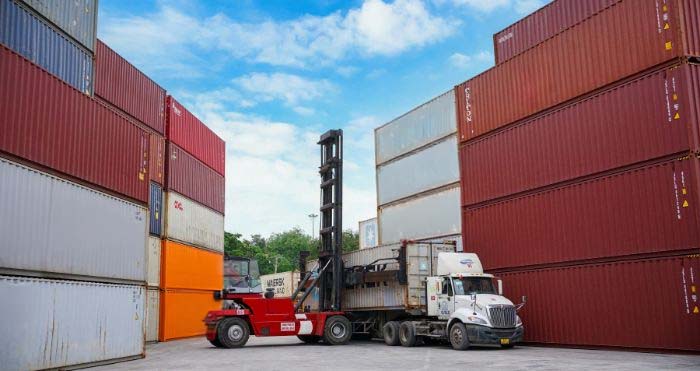
The historical origin of General Average can go a long way towards understanding the term, so let’s imagine, for a moment, that we have taken a step back in time. You are a merchant in the late Roman Empire, around 235 AD, and you are suddenly staring down a problem that is nearly as old as the concept of seaborne mercantilism itself.
Read MoreThe historical origin of General Average can go a long way towards understanding the term, so let’s imagine, for a moment, that we have taken a step back in time. You are a merchant in the late Roman Empire, around 235 AD, and you are suddenly staring down a problem that is nearly as old as the concept of seaborne mercantilism itself.
A ship has returned to harbor that ran into trouble on the high seas and had to throw some of cargo overboard in order to make it back to port at all. Perhaps there was a fire, or a storm, or they needed to jettison some of it to outrun raiders; the reason doesn’t really matter, so long as the cause was outside this ancient carrier’s fault, and that your olives now reside at the bottom of the Mediterranean while your competitors get rich off the back of an act of God.
Now, you, as this Roman merchant, are wondering exactly how you are going to recoup those losses. Lucky for you, a legal concept that was recently unearthed in Rhodes from around 800 BC is being introduced to Roman law, and it is exactly what you need.
That solution would come to be known as ‘General Average,’ and despite its advanced age, it is a legal principle that is increasingly important to modern importers - especially during turbulent times.
What is a ‘General Average’?
The original writing of the law was something to the effect of -
If merchandise is thrown overboard for the purpose of lightening a ship, the loss is made good by the assessment of all which is made for the benefit of all.
Put another way, if goods are sacrificed in the name of saving a ship and its cargo, then every party involved should proportionally share the burden of the costs involved.
Let’s say, for a modern example, a container ship is caught in a storm, and the decision is made to jettison over 100 shipping containers to lighten the load. The owners of those 100 containers do not have to bear the cost of that loss alone. Instead, the ship owner and the owners of every other container must pay a proportional cost.
Once a ship owner declares that this misfortune is a ‘General Average’ situation, your goods will be held until your portion of the cost is paid.
What Events Qualify as Force Majeure?
Force Majeure (meaning superior force) is a term in maritime law that essentially works to free ocean carriers from liability related to unforeseen, unavoidable, or ‘act of God’ type events. For example, a carrier cannot be held liable for a hurricane, earthquake, tsunami, or even human events like strikes, wars, or piracy.
There are typically three ‘tests’ that work to determine if an event is a Force Majeure case. The event must be unforeseeable, external, and unavoidable. Notably, it can be incredibly difficult to actually prove that any of these events qualify, and the question of who bears the financial burden of necessary diversions is deceptively complex, but it still remains an important piece of the ocean transport puzzle.
Force Majeure and General Average interact like two interlocking gears because Force Majeure cases are, in nearly every case, the instigating event that leads to a General Average declaration. A ship that catches fire due to non-Force Majeure causes, like negligence from the crew, is liable for the damages to the goods aboard; a rogue wave that forces the abandonment of some of the cargo is outside their hands, and therefore a different matter altogether.
Force Majeure laws effectively serve as a carrier’s shield. A hurricane that destroys your goods is promptly washed from the carrier’s hands as Force Majeure, and a General Average is instigated to recoup the loss. Which is why, regardless of which side of this affair you are on, marine insurance for your goods is so important.
How Can I Protect Myself and My Shipments?
The hard truth of the matter is that due to the possibility of General Average or Force Majeure events, insurance is very nearly a necessity for overseas shipments, regardless of the size of your shipment.
Consider the following: let’s imagine that you are importing small plastic toys with a total value of $100,000. What you don’t know is that, regardless of the size of your shipment, you are one fire or wave away from being on the hook for a portion of the damage incurred to the multimillion-dollar shipment that shares the same deckspace on the boat as you. If you do not have insurance, your portion of the General Average could very easily exceed the cost of your shipment entirely - and if you don’t pay, you don’t get your goods.
There are, generally speaking, two kinds of marine insurance for overseas transport:
Named Perils Coverage - This covers your goods against specific issues that are listed in the policy, including fire, collision, or theft.
All-Risk Coverage - This covers, as the name might suggest, any possible damage or loss your goods might incur, with the exception of situations and exclusions named in the policy itself.
The difference between named perils and all-risk cargo insurance is an important one, and those who engage in ocean freight must be careful when choosing an insurance option because they do not all cover General Average. Which can be doubly painful when you assume that it does. Getting all-risks coverage is the surest way to make sure you are covered when engaging in ocean shipping, and the best way to do that is to work closely with your freight forwarder to determine the level of protection that works best for you.
PCB Freight is proud to offer freight insurance for our clients, and we highly recommend working through us, as we can help you get exactly what you need to protect yourself from the unforeseen.
We are a trusted source that has helped thousands of importers, and working with someone who knows what you’re going to need before you need it can be a major difference-maker - especially in a place as unpredictable as the high seas.
While the cost of General Average can be scary, its benefits are obvious - everyone aboard is in it together, just like how we’re in it together with you. So get in touch - our team is ready to lend a hand at every part of your ocean shipping journey - especially when things go overboard!
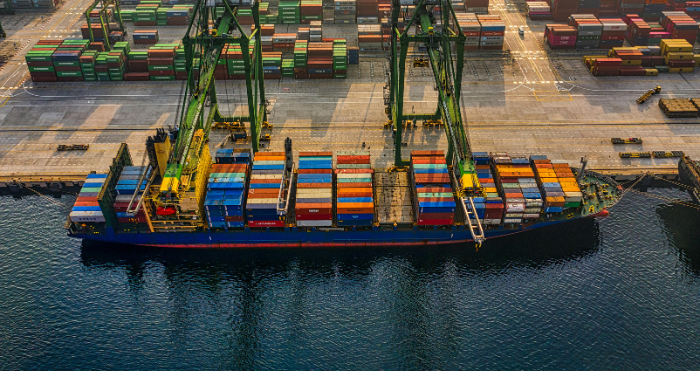
Ocean freight is one of the more complex transport options for your goods as they traverse the globe, and understanding the trade terminology is often an uphill battle.
Read MoreOcean freight is one of the more complex transport options for your goods as they traverse the globe, and understanding the trade terminology is often an uphill battle. However, while we always encourage you to work closely with a freight forwarder through the heavy lifting, understanding this terminology can help you be more informed and make more accurate decisions when building your supply chain.
Today, we’re going to look at some of the more common terms and acronyms that are used in the world of ocean freight and try to break them down in layman's terms so you can engage with this transport type as effectively as possible. Many of them indicate different ocean freight shipping container sizes, but knowing the options can be important when considering how you want your goods shipped.
Transportation Terms
CY/CY
CY/CY stands for ‘Container Yard to Container Yard’. It refers to when an ocean carrier is contracted to move goods from a designated container yard at the origin to a designated container yard at the destination.
Importantly, all transport costs to and from these container yards are typically not included in the contracted price.
Port/Port
In a very similar vein to CY/CY, Port/Port refers to moving a container from the port of loading to the port of discharge. Also, similarly to CY/CY, all costs required for the transport to and from these ports, up to and including terminal charges, are not included in the contracted price.
Free In/Free Out
A slight advancement on the Port/Port terms, Free In/Free Out, is most commonly used in the Mediterranean. Shippers under Free In/Free Out contracts are responsible for the relevant terminal charges at both ends. The ocean carrier is simply contracted to ship the container from one port to another.
Unlike Port/Port terms, Free In/Free Out makes it clear from the outset that the shipper must pay any relevant terminal charges.
Full Container Load Vs Less Than Container Load
FCL
FCL stands for ‘Full Container Load’. Generally speaking, this means that shippers have paid for the whole container to move from point to point. In nearly every case, there will be just one shipper per container. The common examples for this are for car manufacturers, coffee roasters, and agricultural enterprises, which can afford to have a whole container to themselves. Most smaller retailers leverage LCLs as detailed below.
LCL
LCL stands for ‘less than container load’. Sometimes, a shipper will not need a full container for their goods, and in such cases, the shipper can book just a portion of the container. This arrangement is an LCL.
Under these terms, the shipper is charged only for the portion of the container the freight occupies. As a point of caution, in most cases, the cost of shipping LCL is significantly less than that of an FCL. However, as there are other shippers in the container, LCL shipping does take more time, as there is coordination with multiple shippers to fill an entire container.
Liner Terms
Liner Terms are most commonly used when carriers contract space amongst each other. A shipper who has contracted liner terms with the carrier is not responsible for any terminal handling charges. The terms of the contract will cover all port charges at origin and destination.
Types of Ocean Freight Shipping Containers
GP, ST, STD
GP, ST, and STD stand for ‘General Purpose’ or ‘Standard,’ and they refer to the size and type of a typical container. If you are looking for the container sizes for standard ocean freight, GP, ST, and STD are the ones.
Standard container sizes are 20’ or 40’ long with a height of 8’6”. Standard or general-purpose containers are able to carry cargo that does not require protection from heat or cold, and that does not need to be kept cool or frozen. All containers are 8’ in width.
As you might expect, the 20’ container costs less than the 40’; however, it doesn’t necessarily work out to half the cost. A general rule of thumb is that a 40’ is about the average container cost, and a 20’ is about 75% of that.
HC, HQ
High Cube Containers are similar to standard containers, with the exception that they are 9’6” in height. As they are larger, they generally cost slightly more to ship than standard containers, though not always. Several trades today price 40’ HC containers the same as the 40’ Standard.
45’, H5’
In very specific trades, ocean carriers will offer 45’ containers. These containers are 45’ long and 9’6” high. The additional cost of shipping a 45’ over a standard or High Cube can range from an additional cost of 25-30%.
RE, RF
RE and RF are abbreviations for refrigerated containers. Refrigerated containers come in both the 20’ and 40’ HC sizes. They are designed to keep products frozen, cool, or heated for several weeks at a time. Some refrigerated containers can even keep products frozen well below -50 Celcius. Bear in mind that the cost to ship a refrigerated container is significantly higher than that of a standard box.
OT
OT stands for ‘open top’ and refers to open top containers. Many products require loading from the top of the container, and to meet this demand, shipping lines have produced specialized containers that have the roof removed. Generally speaking, the roof is replaced with a tarp, which can be removed to allow for access and top-loading before being reattached to protect the product.
Open top containers are generally in limited supply, so the cost of shipping is higher than that of a standard container. The cost often depends on availability with individual carriers, so if a shipper requires an open-top container, it may be necessary to contact several shipping lines.
FR
FR stands for ‘Flatrack’ containers. These containers have the sides and roof removed, which allows for side or top loading. Freight moving on Flatrack containers is generally oversized and may be overwidth.
—
Of course, this is just a brief overview of some of the terminology related to ocean transportation, and if you are confused by it, not to fear, PCB Freight Management is here to help you through the process.
We also offer additional support in the form of our Ocean Transaction Guide, which can help you understand the roles and responsibilities that make up an ocean transaction.
When establishing your supply chain, we have the team, the experience, and the knowledge to maximize your efforts and ensure your goods get where they are going as expeditiously as possible. Explore our ocean freight service offerings, and when you are ready to hit the high seas, be sure to get in touch!

ATA Carnets, or just ‘Carnets’ for short, when appropriately applied for and used, can serve as a significant shortcut when managing the importation of temporary goods across multiple countries.
Read MoreWhat do these situations have in common?
- It’s trade show season, and a business is gearing up to hit the road on a whirlwind tour, showing off its goods directly to its clients, customers, and other businesses.
- A manager is planning the details of a traveling circus, including the movements of tents, stages, and stands.
- An indie band is going on a road trip across North America, and their van carries all their guitars, drums, and electronic equipment.
If you said that all of these situations involve the international travel of non-consumable items intended for re-export, then that is a very specific answer, but it is correct. We would also have accepted that each case, under normal circumstances, involves a mountain of paperwork, reams of forms and documents, and a host of often laborious regulations to work through. The good news is that they will all also benefit greatly from the use of an ATA Carnet, also known as a "Merchandise Passport".
ATA Carnets, or just ‘Carnets’ for short, when appropriately applied for and used, can serve as a significant shortcut when managing the importation of temporary goods across multiple countries. Effectively, giving your goods what they need to move through countries quickly and easily, but the process involved in acquiring one is thorough, and the rules around their use are strict, so the more you know about what you’re getting into, the better.
What is an ATA Carnet?
A Carnet is a document first founded by the World Customs Organization (WCO) in 1961. It is an internationally recognized piece of Customs documentation that allows for duty-free and tax-free movement through ports of entry in over 80 countries.
Functionally, it serves as a cross-border facilitator for the temporary importation of goods intended for re-export. To be clear, goods benefiting from a Carnet still need to meet any participating or partnering government agency requirements needed to import the goods - even temporarily, but for organizations or enterprises that intend to travel through multiple countries in a short period of time, it is a way to move a pre-approved list of goods across borders relatively headache-free.
The best examples of organizations that benefit from Carnets are companies that need to move trade show gear, media or production companies, or traveling performers like circuses or traveling bands.
What Can and Cannot Travel on a Carnet
Carnets are highly specific in their use case, and Customs is very careful to make sure that every ‘i’ is dotted and every ‘t’ crossed when it comes to their use. Eligible goods for ATA Carnet coverage are those that are intended to come back exactly as they left and without having entered the commerce of the country you are visiting.
The unofficial ‘big three’ of what can be covered by a Carnet include:
- Commercial Samples - these include prototypes, machinery, clothing samples, jewelry, etc. Fundamentally, anything you want to show off and then bring back with you.
- Professional Equipment - These are goods that are used as part of a job in the country you are visiting. The classic examples are TV equipment, musical instruments, testing equipment, etc.
- Exhibition Goods - These are your tents, chairs, table cloths, stage dressings, or other goods that are necessary background items for exhibitions, trade shows, conferences, or concerts.
By the same token, ineligible goods include anything that is consumable, disposable, or intended for sale, repair, or distribution while abroad. These goods have their own processes and must be imported through standard channels.
The best way to ensure you have what you need is to work closely with your broker or connect with our Trade Advisory Team.
How do I get a Carnet?
Carnets are issued through what is referred to as your country’s ‘National Guaranteeing Association.’ In Canada, this is the Canadian Chamber of Commerce, and in the US, it is run through the United States Council for International Business (USCIB).
Of course, there are very specific processes required and minute differences between the two organizations, and you are encouraged to check out the website for the Canadian Chamber of Commerce and the USCIB for specific application requirements, but in general, you will need the following information at the ready:
- A brief description of the nature of your trip and what purpose your temporarily imported goods will be serving. Often, the modes of transportation are a required step for this part as well.
- A precise, detailed list of the goods that will be traveling under the Carnet. This includes descriptions, serial numbers, quantities, values, weights, and countries of origin for the goods.
- Information on the ‘authorized representatives’ of your Carnet, or in other words, those who will be handling the goods and the physical document.
- An itinerary of the countries you intend to travel to with the goods.
- An established security bond set at, typically, 40% of the value of the goods.
ATA Carnet Validity Period and Extension Rules
In general, Carnets are valid for 12 months from the date of their issuance. In a very technical sense, they are not extended, but instead are replaced by what is referred to as a ‘replacement Carnet.’ The replacement extends the 12-month limit, must be applied for before the old one expires, and isn’t always accepted in every country.
What to Do if Carnet Goods are Lost or Stolen Internationally
One of the more common questions we receive about Carnets is what happens if the goods are lost, stolen, or otherwise not exported while abroad, and the short answer is - it’s not great news.
Generally speaking, if the goods are not returned, the national guaranteeing association must pay 110% of the import duties and taxes imposed by the country’s Customs. Then, they will, in turn, come to you to collect the money owed.
It’s important to note that a Carnet is a customs document, not insurance, and it simply does not protect you from lost or stolen goods, nor the duties owed after what is, effectively, a permanent importation.
—
PCB can help set you on the right track when applying for a Carnet, and contacting a broker should always be your first step when moving goods internationally. For guidance on this process, do not hesitate to get in touch with our team at any point in the process.

Summer is here at last, and many people are looking to the US for vacation destinations.
Read MoreSummer is here at last, and many people are looking to the US for vacation destinations. However, before you hit the road, bear in mind that there is much to consider when crossing into the US, and not the least of which is what you are bringing with you. There are many regulations and rules that you may not have even considered, but absolutely apply to recreational travel into the US, and the better informed you are, the better off you will be when you arrive at Customs.
For example, do you know what documentation is required for your furry friend riding shotgun? Can you bring a potted plant to your Aunty Jean in Vermont? Is your car something that Customs and Border Protection (CBP) views as an import requiring declaration? And that’s just where it starts - there are as many questions as there are miles of road for you to explore, so let’s have a look at some of the most common ones and see what pitfalls we can avoid this summer.
Bringing Pets Into The US Temporarily
Traveling with pets is common, especially when traveling, but be aware that there are quite a few things that you need to have when bringing a pet into the US, especially if it’s a dog.
Traveling with a Dog
If you are traveling to the US with a puppy, there are a host of Center for Disease Control and Prevention (CDC) dog-related regulations that you will need to meet before you can be allowed to do so.
These regulations include what you need to have with you when you arrive at the border, what you need to have prepared ahead of time, and what processes your furry co-pilot will need to have gone through before you can bring them into the US.
For a full breakdown of what you need to have, check out the CDC’s Dog Importation website and our own infographic covering what you need at a glance.
Traveling with a Cat
It will come as no surprise to Garfield fans that traveling with a cat is a much simpler affair than traveling with a dog, but there are still some considerations to keep in mind as you head for the border.
- The CDC has no import form or rabies certificate requirements for cats; still, some individual states and airlines may have unique certificate or vaccination requirements. It is wise to investigate the destination state for individual rulings.
- Cats are subject to inspections at the border, and if it appears ill, you may be denied entry or required to pay for a veterinary examination at the port of entry.
Food and Other Perishable Items
Customs and Border Protection (CBP) food restrictions are relatively light when it comes to recreational transportation, and most food items are generally permitted to enter the US. However, certain regions or countries may have specific restrictions to consider, so always be careful and check when bringing fruits, meats, plants, cut flowers, pet food, and live animals across the border.
Regardless of the type, all food items must be declared at ports of entry, especially agricultural items, and failure to do so may result in significant fines and penalties up to $10,000. With that in mind, consider shopping in the US if you can.
Still, if you’re looking to load up before you head out, here is a list of CBP-approved items:
- Condiments: ketchup (catsup), mustard, mayonnaise, Marmite, Vegemite, and prepared sauces that do not contain meat products
- Olive oil and other vegetable oils
- Bread, cookies, crackers, cakes, granola bars, cereal, and other baked and processed products
- Candy and chocolate
- Cheese - Solid cheese that does not contain meat is admissible
- Liquid milk and milk products intended for use by infants or very young children are admissible for several days if in a reasonable amount or small quantity
- Juices - Commercially packaged
- Tea - Commercially packaged and ready to be boiled, steeped, or microwaved in liquid. Coca, barberry, and loose citrus leaves are prohibited
- Spices - most dried spices are allowed except for orange, lemon, lime, and other citrus leaves and seeds, lemongrass, and many vegetable and fruit seeds
- Noodles and ramen that do not have animal products in the ingredients
- Flour
- Mushrooms - fresh, dried, and above-ground parts that are clean and free of soil.
- Nuts - Roasted
- Bakery items, candy, chocolate, and dry mixes containing dairy and egg ingredients, commercially labeled and presented in final finished packaging, are generally admissible
The following items are admissible according to CBP:
- Aloe - above-ground parts
- Coconuts - husks must have been completely removed and cannot have sprouted
- Garlic - peeled cloves
- Ginger - clean roots
- St. John's bread - pod
- Water chestnut - corm or nut only
Recreational Vehicles
There’s nothing quite like RV travel in the summertime, but does your vehicle need special considerations when entering the US? The answer is that, regardless of whether they are owned vehicles or rented RVs, recreational vehicles are generally permitted entry into the US.
With that said, the following travel documents could be required upon arrival:
- A valid driver's license
- A copy of your RV rental agreement or registration (Written authorization from the rental company may be required)
- A valid passport (if applicable)
- Insurance certificate for the RV
Additionally, according to the National Highway Traffic Safety Administration, a vehicle registered in a country other than the US may enter the US for personal use by a non-US resident for up to one year.
Gifts and Cash
Any amount of money that exceeds $10,000 USD must be declared at US Customs upon arrival. The following forms are the ones required by CBP for the declaration of that money:
- CBP Form 6059B: This form provides US Customs with basic information about the traveler and what goods they bring into the US. One form can be completed for your entire family instead of each person filling out a form with essentially the same information.
- FinCEN Form 105: This form must be completed by travelers carrying cash or monetary instruments. Upon arrival in the US, travelers should file this form.
Additionally, any gifts you are bringing into the US must be declared at Customs. It is good practice not to wrap these gifts, as they will likely need to be unwrapped if Customs decides to inspect them.
CBP guidelines state that, “Gifts you bring back for personal use must be declared.” However, alcoholic beverages, tobacco products, and perfume having a retail value of more than $5.00 are excluded from the gift exemption.
Other Restricted Items
In general, most items are allowed into the US, especially when brought in for recreational use. However, there are several exceptions that are restricted or outright prohibited by CBP. It is also worth noting that many items are restricted on a state-by-state basis, and as such, the regulations in force could fluctuate based on where you are traveling to.
Some of the more common items that run into issues at Customs due to the items being prohibited or regulated include:
- Firearms, weapons, and ammunition: You must have a valid purpose for bringing them, such as hunting during hunting season, competitions, repair, etc.
- Fireworks: According to the Bureau of Alcohol, Tobacco, Firearms, and Explosives (ATF), any person importing or transporting display fireworks must obtain a federal explosives license or permit from ATF. Examples of display fireworks include those used in professional displays. The ATF does not regulate the import and transport of completed consumer fireworks, such as those purchased from a stand; however, some US states do, which may require certificates or permits. Consumer fireworks are regulated by the US Consumer Product Safety Commission (CPSC).
- Cannabis and Cannabis products: While Canada has legalized cannabis for both recreational and medicinal purposes, and several US states have done the same, it's important to note that cannabis remains a controlled substance at the federal level and is illegal in the US. Therefore, attempting to cross with cannabis products will likely result in refusals, seizures, penalties, and criminal charges. It can also create challenges for your future access to the US.
—
Knowing what you need before you go is just as important when traveling recreationally as it is when importing for commercial purposes. The best way to ensure a smooth crossing is to be fully prepared and aware of the regulations and requirements you may be responsible for.
You are encouraged to stay informed by downloading our helpful US Summer Cross-Border Recreation Guide. With it at your side, you’ll have your summer adventure start easily and stress-free!


It is another glorious summer, and if you’re looking for adventure, then there is no better place to go than the beautiful Canadian frontier!
Read MoreIt is another glorious summer, and if you’re looking for adventure, then there is no better place to go than the beautiful Canadian frontier! However, entering Canada, even for recreation, comes with rules and regulations, especially regarding what is and isn’t allowed into the country. For example, do you know what items in your trunk are legally prohibited in Canada? Do you know what goods in your cooler need to be formally declared before entering? And what documentation is required to bring the things in your backpack into the country?
In this blog, we look at the common pitfalls of summer-time travelers to the great white north, and what steps you can take to avoid them!
Bringing Pets into Canada
The Canada Border Services Agency (CBSA) is the government agency most concerned with Canadian border crossing rules, including what is and is not allowed into the country. Included in that concern are any furry friends riding shotgun on your summer trip north. Whether they are staying or entering on a temporary basis, there are rules that CBSA enforces for the Canadian Food Inspection Agency (CFIA) for Fido’s entry based on the animal's type and age.
These rules include what you need to have on you when you get to the border, what you need to have registered ahead of time, and what processes you will need to have gone through before you can bring Rover with you. Whether it’s documentation like a valid rabies vaccination certificate or a microchip, knowing is over half the battle when it comes to bringing pets into Canada.
For a complete breakdown of everything that you need to know regarding how to import dogs into Canada, it is best that you read through our full Dog Import Requirements Guide and the Canadian Food Inspection Agency (CFIA)’s Traveling with a Pet documentation.
Food and Other Perishables
There are some Canadian Customs food restrictions in play - even for recreational travel. According to the CBSA, all food, plants, animals, and their related products must be declared before being brought into the country. The list of things that this includes might surprise you, and includes things like:
- Homemade food
- Hand-made wooden crafts
- Fishing bait
- Plants - even those used for homeopathic or medicinal purposes.
A declaration is how CBSA manages and determines the risk involved with the goods you are bringing across the border. The concern is largely related to diseases and invasive species that might tag along for your summer vacation.
Importantly, it doesn’t matter if the goods are grown in Canada originally - it must be properly declared if you are trying to bring them into the country!
Recreational Vehicles
Vehicles, in most cases, do not require any special declarations if they are not intended for commercial use, including boats, motor homes, and personal cars, trucks, and motorcycles. If you are unsure whether your vehicle will require a specific piece of documentation to come into the country, it is best that you have a look at Transport Canada’s page on the temporary importation of vehicles and the CBSA’s page on the reporting requirements for private boat operators, with additional information on specific vehicle needs.
Amid the requirements above, there are two specific notes worth pointing out with regard to the stop of invasive species:
- Personal boats must be clean and the bilge empty before they enter the country.
- Off and on-road vehicles and equipment must be clean and free of soil and soil-related matter.
Cash and Gifts
The rule when declaring cash or gifts at the Canadian border is that it must be declared if it is in excess of $10,000 Canadian dollars. Notably, if your cash is in US dollars, it will need to be calculated to the Canadian dollar amount before crossing.
Gifts, if they follow the rules above, are fine to bring in (so long as they don’t include alcohol, tobacco, or vaping products), but as a word of caution - be sure to leave them unwrapped, as the CBSA may wish to see the gift and will, unfortunately, need to unwrap it. As a pro-tip, bring your wrapping stuff with you and wrap your gifts once you cross.
Other Restricted Items
The CBSA has made it fairly easy to enter the country for recreation, and most personal goods are allowed. However, there is a subset of goods prohibited at the Canadian border that require special action to be brought along with you, including permits and special permissions. These goods include (but are not limited to):
- Firearms, weapons, and ammunition (with some exceptions in place for specific use cases like competitions and hunting)
- Explosives, including fireworks.
- Cannabis and cannabis products, such as CBD Oil (regardless of the legality of your origin or destination)
As a final note, bear in mind that certain consumer goods allowed in your country may not be allowed in Canada, for example, baby walkers.
Traveling to Canada is intended to be a fairly straightforward process, and with a very modest amount of diligence, it will be! Just be careful of what you are transporting with you, which of those things need to be declared, and that you have everything you need for the things you are bringing.
For a free and printable guide on what you need to know when traveling to Canada, you can find one here.


Many importers are currently confused about which tariffs are being refunded, which are being newly applied, and what money you can get back from Customs and Border Protection (CBP) right now.
Read MoreMany importers are currently confused about which tariffs are being refunded, which are being newly applied, and what money you can get back from Customs and Border Protection (CBP) right now.
Let us answer your questions about this process, so you can more effectively get back the money you are owed.
Here is a quick summary, with further details below:
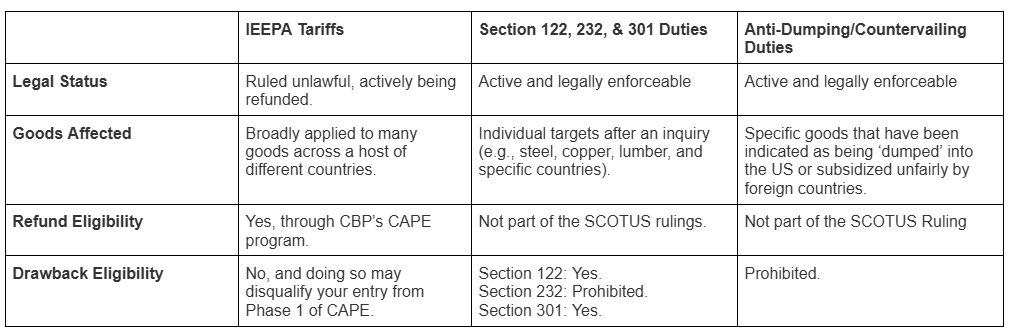
What is an ‘IEEPA Tariff’?
The International Emergency Economic Powers Act, or “IEEPA,” was the legal provision the US Government attempted to use to implement a set of international tariffs over the past year.
These tariffs were then struck down as illegal by the Supreme Court in 2026.
Are They Still in Effect?
No.
The tariffs that were imposed under IEEPA were struck down by the US Supreme Court on February 20, 2026, as illegal. Collection for these tariffs ended on February 24, 2026, following the Supreme Court order. As such, the US government is developing and deploying functionality to assist with the filing and refund process.
Can I get a Refund on an IEEPA Tariff?
To find out whether you are eligible for a refund or whether any of the duties you paid in the last year were IEEPA tariffs, we recommend a review. Once identified, these can be filed via the CAPE functionality in the ACE portal by the Importer of Record or the Broker of Record.
All of our services related to preparing for and receiving a CAPE refund can be found on our CAPE Refund Preparedness service page."
All of our services related to preparing for and receiving a CAPE refund can be found on our CAPE Refund Preparedness service page.
—
What is CAPE?
CBP’s Consolidated Administration and Processing of Entries (CAPE) program is the newly implemented process for importers owed refunds for the IEEPA tariffs. It allows for consolidated filing of your entries and the calculation of interest owed. It is the system in which the importer of the filing broker can request those refunds, and where the processing of those refunds will take place.
This is being rolled out in phases, with Phase 1, which began on April 20, 2026. Complete information on how this process is unfolding can be found on our blog post covering the complete details, and further updates are consistently being added as they happen on our Tariff Resource Page.
More information about CAPE and the services PCB can offer to help you with this is available on our CAPE Refund Page.
—
Anti-Dumping/Countervailing, Section 122, 232, 301 Duty?
The section duties (122, 232, and 301) are currently active duties that are applied to specific commodities and derivatives of specific countries, respectively.
At this time of this writing, a unilateral 10% tariff under the auspices of Section 122 is in effect on most goods from all countries.
Under Section 232, specific commodities are targeted for tariffs. For example, there are cases on steel, aluminum, copper, autos, lumber, etc. It is important to note that there are also new investigations currently underway looking at different industry sectors.
Certain Section 301 tariffs have been applied to specific countries. For example, the most well-known Section 301 case is levied against China.
These are not to be confused with Anti-Dumping/Countervailing duties, which are entirely separate from IEEPA and the section orders listed above.
Section 122
Section 122 is designed to address balance of payment issues and address trade deficits between the US and other countries. The catch, and primary difference between this and the IEEPA tariffs, is that it is capped at a maximum of 15% and can only be applied for 150 days before requiring a Congressionally approved extension. They were implemented on February 24, 2026, and therefore will be up for termination or extension on July 24, 2026.
Notably, the 15% cap is unique to Section 122; the other sections are not subject to such a limitation.
Section 232
These tariffs are implemented in the name of national security. The classic example of this is steel. If it can be proven through an inquiry that the importation of foreign-produced steel would damage domestic production irretrievably, then a Section 232 tariff could be introduced to keep US steel competitive.
Section 232 tariffs specifically exclude a duty drawback option.
Section 301
Section 301 tariffs are implemented to balance against unfair trade practices from other countries. The best example being China, which has had a 301 tariff implemented at varying degrees over the years.
There are currently investigations into over 60 economies for future Section 301 Tariffs.
Anti-Dumping/Countervailing Duties
Anti-dumping/Countervailing (AD/CVD) duties are highly targeted tariffs that are entirely separate from IEEPA and the section duties. AD is placed on highly specific goods that are sold in the US at an artificially low price in an effort to protect US industries. CVD is placed on goods that are priced artificially low as a result of a foreign subsidy.
It is easy to confuse these - especially Section 301, which sounds incredibly similar. The difference is the scope - AD/CVD are targeted to specific products, while the sections are levied against countries as a whole.
It is imperative that you understand that they are unaffected by each other. There is no refund or drawback option on AD/CVD. They seem similar, but they are utterly divorced in the eyes of CBP.
Due to the fact that these tariffs are currently legal and active, they are not currently eligible for refunds under normal circumstances.
Can I get a Drawback on the New Tariffs?
According to CBP, the newly implemented Section 232 and Antidumping / Countervailing tariffs specifically prohibit duty drawback, while Section 122 and 301 duties remain eligible for duty drawback.
However, as is always the case, drawback is strictly prohibited on goods affected by AD/CVD.
IMPORTANT NOTE: Do not apply for duty drawback on entries that could qualify for a CAPE refund. This may disqualify them from being included in Phase 1 of CAPE.

The time when Canada’s primary exports are cold fronts and hockey players is rapidly coming to an end, and it is becoming clear that Canada’s time as a key player in the international marketplace may only just be beginning.
Read MoreHow to Be a Canadian Exporter
The time when Canada’s primary exports are cold fronts and hockey players is rapidly coming to an end, and it is becoming clear that Canada’s time as a key player in the international marketplace may only just be beginning. With the sky being the limit and more opportunities than ever for the growth of Canadian exports, now is the time for businesses to make a big move and strike while the iron is hot.
The subject of tariffs and trade barriers remains high on the international political agenda, and there are no indications that things will return to the way they were any time soon. Add to that an increased level of support from the government and trade organizations at large in Canada, and suddenly, one of the surest ways forward in this current climate is to spread to as many markets as possible.
If you have not been exploring diversification options, then now is the time to start looking as far afield as you can, and sooner is going to be better than later. The more you work to diversify your markets and put the work in to bring your goods to the world at large, the better off you will be in the long run.
This is the time to learn, grow, and find your way into new international markets, and in today’s post, we’re going to touch on the services, organizations, best practices, and policies that might just help your business thrive in the months and years to come.
What are Canada’s Free Trade Agreements
One of the largest challenges facing new Canadian exporters is the question of where exactly they should take their goods. After all, it’s a wide world out there, and not every product is going to be a prime market match. Fortunately, there is a convenient signpost that can help identify a good marketplace: free trade agreements (FTAs).
Canada maintains around 15 FTAs at any given time, and with the right guidance, they can be exactly what you need to find a purchase in unfamiliar terrain. For those looking to expand transcontinentally, Canada's Free Trade Agreement can reduce tariffs and duties on your goods, and is a clear indicator of nations on a similar trade wavelength. An FTA can be your roadmap to success, both financially and in helping you identify the new market most receptive to your efforts.
With that in mind, there are two critical considerations worth entertaining before you embark on this. The first is that this will require you to reassess your Incoterms® while expanding globally, as establishing your relationship as a seller in a new market ecosystem is a high priority and critical to your success abroad. Knowing your Incoterms® and making sure they are appropriate for your new business working relationships can help establish you well in the early days.
For additional assistance with Incoterms®, you are encouraged to head to the PCB Learning Center and sign up for one of our Incoterm® courses.
The second is that while an FTA is a good indicator of a trade match, it doesn’t necessarily indicate demand, nor does it give the details you need to actually export your goods there. It’s a good place to start, but research is still important, and one of the first things you are going to need to understand is the country's rules of origin. The rules of origin for a country could be fundamentally different than what you are used to, particularly if you are used to exporting exclusively to the US, and knowing what you need to know ahead of time is going to be vitally important to your success.
For both these matters, it is highly recommended that you work with a skilled trade advisory team, like the one you’ll find at PCB, who can make sure that you are well-positioned to take advantage of this new marketplace while having all the information you need. PCB’s FTA Review service can look for opportunities that you may not have known existed and help you take full advantage of them.
It’s Time to Diversify
Diversifying your business is always a great idea, but right now, it is also taking advantage of a unique opportunity. Canadian companies, in particular, are well-positioned to benefit from a host of programs already in place that aim to give you what you need to thrive in the current marketplace. Earlier this year, the Canadian Government suggested that it would endeavor to support and expand its international exports by up to double in 2026.
Admittedly, it’s always a risk to take your goods to the wider world, but it’s a risk that is currently supported by government programs at a time when it is bullish on getting Canadian goods abroad. That support can be a critical part of your strategy that could potentially make all the difference.
Currently, there are several programs in place to help exporters find markets abroad, and they are covered in detail in our Canadian Export Guide. In addition to that guide, PCB also offers support to exporters through our Export Service Page, our CERS Support Service, and our upcoming Exporting from Canada Webinar. For information on those offerings or any of the ways that PCB can help you bring your goods to the world, be sure to get in touch - we’re eager to help.
Eyes and Freight Forward!
Logistics is another potential hurdle for new exporters, and depending on how far afield you are taking your wares, it could represent several fundamental shifts in how you have transported goods in the past, including modes you may not be familiar with.
A skilled freight team can get your goods up and running across the globe and can soften the transition to new forms of transport. It is common that new exporters find their footing through the vetted connections of a local freight forwarder, so that they know what they will need to succeed abroad.
One of the key pieces of this puzzle is the ‘freight network.’ If you are unfamiliar, essentially, most freight companies are members of these international networks and offer support to other organizations within the network. For example, PCB could be your forwarder here in Canada, but we also work closely with a different company in our network to support your efforts in Europe or beyond. Getting assistance in this arena can often be the difference between success and failure for new exporters, and what it offers is keen insights into what challenges or requirements are necessary in other countries.
It is crucial that you work with a trusted freight management company, such as PCB Freight Management, and its associated networks to find the best carriers for your logistics chain abroad.
PCB works with several prestigious networks, including:
That means we have more points of contact across the globe, so your goods can get to where they need to be through trusted, vetted carriers.
For more information about PCB Freight or the various services it can provide for you, be sure to check out our website detailing the many different services we can offer exporters looking to bring their goods to the wider world.
The World is Waiting for You!
If there is one thing to take away from this, let it be this - now is the time to make a big move and get your goods to the wider world. Not only can you count on PCB to help you, but you also have the support of the Canadian Government. This is the sound of opportunity knocking, and you need to open the door.
For more information about how to get started exporting, be sure to check out our new export guide, our exporting into Canada service site, our CERS reporting service, and our upcoming webinar. Together, we cover these topics in greater detail and add a host of information about the processes you will need to undertake and the programs that can help you make your efforts a success.
Finally, be sure to take a look at our trade advisory services for help tackling a challenge, determining your international marketplace strategy


A new announcement from US Customs and Border Protection has indicated that refunds related to tariffs could be coming sooner than we thought. The technology involved, namely the Consolidated Administration and Process of Entries or CAPE system, seems to be evolving quickly, and a release seems imminent.
Read MoreThe Future of IEEPA Refunds and the CAPE Portal
As you may know, if you have paid tariffs in the past year, you may be eligible for a tariff refund from the US Government as a result of the International Emergency Economic Powers Act (IEEPA) tariffs being deemed illegal. We know that for many importers, this refund may have seemed out of reach, with the question of who qualifies for tariff refunds under IEEPA being answer with costly litigation, but it is beginning to appear that an automated process for recovering these refunds may not be as daunting or complicated of a process as many experts expected, and the system responsible for disseminating these refunds may be coming sooner than anyone could have guessed.
On March 31, 2026, Customs and Border Protection (CBP) released an updated status report on the advancements it has made on the Consolidated Administration and Process of Entries or CAPE system. This system will be responsible for processing and disseminating refunds related to the IEEPA tariffs, and this update has given us a look ahead at how this system will likely work, what the earliest days of its implementation will look like, and what importers need to be doing now to prepare for its release.
How We Got Here
In February of 2026, the US Supreme Court ruled that the IEEPA tariffs were unlawful. The result of that decision is that anyone who paid one of these tariffs is, through the definition of the law, entitled to a refund of that money.
While it sounds simple in concept, the reality is that this represents billions of dollars across almost as many imports. The key challenge is that, at the time of publication, the only recourse for getting this money is to file in court for it - a costly and protracted process that has been flooding the courts since the decision was made.
With that in mind, the question that has loomed large over the whole situation was quite simply: how is a normal person or a small business going to get a refund from CBP? We wrote a blog at the time covering most of the details of this conundrum, but the primary point was that there wasn’t a way, and that a path forward would be difficult to find.
Fortunately, it appears that that may not be the case. In fact, much of the international trade community has been taken by surprise over the past few months by the speed at which a system for processing mass refunds is being developed, and it appears that the implementation of ‘CAPE’ could be closer to weeks rather than months.
How CAPE Will Work - For Now
Of course, this could all easily change over the coming weeks, but as far as we know right now, CAPE is built on an ‘opt-in’ system wherein importers and brokers will need to manually request their refund by submitting the relevant documentation to CAPE via the ACE Portal.
In broad strokes, the CAPE system is built on four key components, with entries moving through these components one at a time until the end result of a refund being dispensed.
Claim Portal
This is the ‘CAPE’ tab in the ACE portal, where importers submit their entry summaries for review. Through that review, the system checks two boxes:
- Is this properly formatted, authorized, and correctly submitted?
- Is this entry real and valid? E.g., checking that the entry exists in ACE and confirming basic validity, including IEEPA indicators in the entry.
Once the entries are confirmed as properly formatted and valid, CAPE moves them to component two.
Mass Processing
During this phase, CAPE strips the IEEPA indicators from entry summaries. It then recalculates the owed duties as if the IEEPA duties were not applied.
Notably, this also ensures that any other necessary duties and taxes are correctly applied in a very similar fashion to a typical liquidation.
Review and Liquidation/Reliquidation
Now approaching the end of the process, entries accepted by CAPE are set to liquidate or to reliquidate. Of particular importance is the fact that CBP retains the ability to conduct a manual review, and if their indications are correct, they plan to use this time effectively, ensuring that your entries are compliant and within the law.
Once set on the schedule, the entry summaries are updated with new duty totals and applicable interest and sent to the final component.
Refund
When the refund date arrives, CAPE begins the refund process, moving through the ACE Collections module, and then distributed to bank accounts through the CBP Automated Clearing House (ACH).
The Latest Updates
With the potential IEEPA tariff refund process explained, the latest is that on March 12, 2026, we received an update that CAPE would undergo a ‘phased roll out’, meaning it would tackle different levels of complexity bit by bit rather than attempt to handle the entirety of its backlog in one attempt. The goal is to get as much money out to as many companies and individuals as quickly as possible.
On March 31, we received further clarity on the phased process, including what will be processed in the early stages of CAPE and what will not be.
Phase One of CAPE’s rollout will be restricted to entries that are “unliquidated or for which the 90-day voluntary reliquidation period […] has not expired.” Notably, it will also accept entries where the liquidation status is suspended, extended, or under review, but refunds from these categories will be delayed and issued only at the end of that liquidation process, rather than as an immediate refund.
Essentially, goods that are still in the process and uncomplicated are the first to receive a refund, and entries that are still having their ultimate fate determined will be on a longer timeline and will receive an updated liquidation as a matter of course.
With that in mind, several types of imports will not be accepted in the first phase of CAPE, namely:
- Entries that are flagged for reconciliation
- Entries with a drawback claim
- Entries not filed in ACE or don’t yet have a liquidation status in ACE
- Entries subject to anti-dumping or countervailing duties (AD/CVD) for which liquidation instructions have been issued by Commerce and are pending liquidation
- Entries that are currently covered by an open protest
So, how long do CBP tariff refunds take in CAPE? CBP expects it will take approximately 45 days from acceptance to review to liquidation for a validated entry, but notes that there is room for delays if a compliance issue necessitates further review.
It also intends to expand the capacities of CAPE during Phase Two and beyond, granting it further tools to ensure compliance, streamline revenue enforcement, and process entries for which “liquidation is final.” They also note a desire to increase their ability to process “non-[ABI] entries where no entry summary lines exist.”
What Do You Do Now?
There are a few key things you need to be considering right now as an importer watching CAPE unfurl. The first and most important point is that this is a golden opportunity for CBP to review the minutiae of your submitted entries and ensure they are up to par. This means that, now, ahead of your submission date, is the ideal time to get your house in order and make sure every ‘T’ is crossed and ‘I’ dotted. CBP has already indicated that they will be ‘spot-checking’ refund submissions to identify compliance issues and offset refunds. Checking your entries now will ensure that your CAPE filing isn’t denied on a technicality, and you will get your money back sooner.
Next, if you have not registered for both the ACE and ACH Portals, then now is the time to do so. This process relies on both of these services, and they can provide vital information and insights into your imports even before the refunds start arriving.
The ACE Portal is the primary point of contact with CBP and will be the keystone of the IEEPA refund process. Registration in this portal involves confirming your 5106 information with CBP, a process that can be time-consuming - particularly right now when interest is at an all-time high, so you are encouraged to verify this as soon as you can. Of course, PCB can help query this information, and we can do so more expeditiously than if you were to attempt it yourself.
ACH manages the payments of imports and serves as a convenient way to interact with CBP financially. In addition to streamlining the process and saving you money on disbursement fees, it is currently the only way that CBP distributes refunds, so registration is critical. It is also worth noting that simply registering in ACH is not the same as preparing to process refunds within ACH - there is an additional step. Be careful and ensure you have taken the necessary steps to receive your refund.
Finally, the question of protests is a bit murky. Additional protests are an option, and PCB can help with them, but they should be carefully considered before proceeding. The truth is that we don’t know exactly what the full shape of this will be, and to what extent protests will hinder your refund efforts.
What we do know is that protested entries may already preclude those goods from being resolved in Phase 1, so they can add a layer of complexity to a process for which waiting for CAPE may be the more cost-effective solution. As always, exercise caution and work closely with your Trade Advisor - especially in these early moments - to find the strategy that works best for you.
—
PCB can help you with virtually every step of this process. From helping you pull together your entries and preparing them for submission to providing you with what you need to register for ACE, all the way to offering support with ACH and guiding you through the protest process, we have the support you need to hit the ground running.
With the help of our team of experts, setting you on the right course, you’ll find that this can be a complex process made simple, and you’ll be ready to receive your refund before you know it.
Get in touch today to get started!


One of the more common concerns we hear about these days is that there is an increased level of scrutiny and work now being applied to goods that were once considered ‘simple imports’.
Read MoreThe End of the ‘Simple Import’
A common concern we hear from importers today is that they are just importing apples, or some other ‘simple’ import. It’s a lament we have heard many times: Importers who once had their goods sail through Customs quickly and easily now find themselves facing what seems like a dramatic uptick in documentation and regulatory requirements. This increase in regulatory concern often feels disproportionate to the entry value and sophistication of the goods being imported, leaving it out of step with what was once considered by the importer as ‘simple.’
Apples are anything but anymore in the eyes of Customs.
To a business unfamiliar with the realities of importing into the US currently, it may be tempting to think that your broker has become overly invested in what seems like tedious minutiae. You might be tempted to question why, if your imports haven’t changed, you are being asked to provide more and more information on those imports. The answer is simple: your imports may not have changed, but everything else has, and the work involved has skyrocketed.
So, how did we get here? How has this division between the complexity of a good from the effort required to process it grown so wide? And now that we’re here, is there even such a thing as an uncomplicated good anymore? Let’s find out together as we mourn the end of the simple import and see what kind of new shape it may still have in the future.
What Happened?
Why is this the case? Maybe it’s just US Customs policies and advanced detection technologies, or maybe it comes from a more political place, like the most recent surge of trade actions and shifting trade priorities. In the end, it’s all correct to a certain extent; there are many different factors at play. What it boils down to is that, from our perspective, at the holistic and ideological level, we are seeing the endgame of a slow structural shift towards a much more rigorous Customs and Border Protection (CBP). Seemingly, industry by industry, and commodity by commodity, Customs has become characterized by more scrutiny and a need for greater detail. Whether it’s a new tariff or Partner Government Agency (PGA) requirements, or an increase in the number of audits, as an organization, it is more exacting in its demands and consistently stricter in its enforcement than ever before.
Add to that using increasingly sophisticated detection apparatus to ensure that importers are in strict compliance, and it’s as far from ‘simple’ at Customs as it has ever been outside of a major incident.
Of course, it is beyond the purview of this blog to wade into the political or speculate on the reasoning behind this apparent change, but what is currently undeniable is that increased scrutiny and compliance requirements for importers are more thorough at every level. From our perspective as brokers and Trade Advisors, we have entered an era where a significantly greater focus is being placed on gathering complete information and determining the veracity of that information before goods are permitted to cross. Ultimately, a more rigorous effort has been made at nearly every level to tighten the belt on imports into the country, with greater onus than ever being placed on the importer to prove that their goods are up to the level.
Let’s take a look at some of the key examples that indicate this overall change in priority at Customs.
The End of De Minimis
Arguably, the quintessential example of the end of the simple import is the suspension of the de minimus exemption. For importers not in the know, or who never benefited from de minimus, the $800-or-less exemption on imported goods and its effect on importers, particularly those in e-commerce, were significant. While it was in effect, any goods that qualified for de minimis were exempt from duty and tax upon entry into the US.
For many businesses, the suspension of this exception was a significant blow to the way they have done things for nearly 100 years. But beyond the financial blow, this ending represented a sweeping increase in regulatory complexity for importers - particularly those engaging in e-commerce. Goods that once required a fraction of the documentation now require a formal or informal entry with complete details for all their shipments, and the work associated with those imports has, as a result, increased by a significant magnitude not only for the importers but for the brokers they employ.
Not only are these importers struggling to come to grips with what exactly they now need in terms of documentation in a post-de minimis suspension world, but the goods themselves are now being scrutinized at the Customs level in the same way that much larger shipments were adding to the time, focus, and complexity of the import.
There’s more to it even than that, though, as now nothing falls beneath the notice of Customs, a factor that will come into play momentarily. However, this is perhaps the most direct example of the end of the simple shipment; the amount of paperwork and consideration required has, seemingly overnight, increased at a level that left many businesses reeling, but other things have been slowly gathering speed as the months have gone on.
The Front Line
Perhaps one of the larger reasons behind this apparent shift in worldview is that over the past few decades, CBP and its related PGAs, along with most of the world, have increasingly been called to serve as a front line against a host of criminal, social, commercial, and political challenges, and of late, this global shift has only accelerated.
From enforcing tariffs to combating fentanyl, counterfeit goods, and products made with forced labor, it’s a gargantuan task by virtually every metric, and as a result, bit by bit, we have seen a necessary move towards a more cooperative approach with importers under the auspices of CBP’s ‘informed compliance’ and ‘shared responsibility’ precepts. ‘Reasonable care’ now often includes the requirement to prove the compliance of their goods with one of the most significant examples, the Uyghur Forced Labor Prevention Act (UFLPA), introduced in 2021.
For those unfamiliar, the UFLPA bans goods from the Xinjiang Uyghur Autonomous Region of China. It was one of the first acts of its kind to implement a ‘rebuttable presumption’ for goods, and what that means is that the importer is obligated to provide the proof of their ‘innocence’ and that their goods did not come from the Xinjiang Region. It is unique as a law in that if you can’t prove it, then your goods will be rejected out of hand.
Combine this with the de minimis being suspended above, and the result is clear: every part of your import is now under the microscope, and no matter the size or cost of the good, nothing is beneath the notice of Customs.
While avoiding goods made with forced labor is inherently a good thing, this means, once again, another hefty increase in the documentation required for even the simplest import.
Of course, there are many other elements we can look at, for example, many sections of goods now require the derivatives of their finished articles to be declared separately, including the appropriate documentation as though that was the good itself. This is a departure from the old way of thinking, where the ‘essential character’ of the article may have been sufficient for declaration, but now it is what regulated parts make up that good, and how much those parts contribute to the value of the article in question.
You then need to consider the relevant PGA filing, which may require an entirely different collection of documentation, and before long, what was once simple has become markedly more complex.
A good imported today may need a base filing, a PGA filing, and anything required for any relevant applicable tariffs, so taken together, it is evidence of a fundamental shift in the perspective of Customs that is increasing the workload for importers, and in doing so, heralding the end of the ‘simple import.’
The New Simple is Trade Advisory
Where does this leave us? The hard truth of the matter is that in 2026, an import is not just an import, and the age of simple declarations is over. The fact of the matter is that there is just no room for this incredibly complex process to be ‘simple’ anymore, no matter the good, and the US Government appears to be ahead of that curve. Now, more than at any other point, more is being asked of importers by Customs, which means now is the time to invest more heavily in intellectual capital and lean on experts more than ever before.
A good trade advisor can bring back the feeling of simplicity in a new form. Having someone who knows what CBP and the PGAs are focused on, while also knowing your goods, supply chain, goals, and business down to the bones, is not just worth the money at this point - it’s nearing necessity.
Brokers and Trade Advisors can help with your import goods, but it is just one part of the puzzle now, and a more comprehensive trade advisory strategy is rapidly becoming the ‘simple’ baseline. The sooner you connect with a trade advisor you can count on, the sooner your imports will start to feel simple again.
—
Of course, if you’re looking for help, PCB is here. Our Trade Advisory team is staffed with tenured experts who are standing by to make sure that your goods have everything they need to cross quickly and efficiently.
You are encouraged to look through our Trade Advisory page for the service that best meets your needs, and when you are ready, get in touch. We’ll be here to help make sure your next import is as simple and easy as possible.

It is once again February, love is in the air, and with it, a sudden influx of flowers, chocolate, and jewelry all arriving at Canadian ports of entry. It’s not uncommon for importers to import special stock or even corporate gifts this time of year, but there are a few things you should know before you get too caught up in the spontaneity of the season, namely, the fact that importing food and flowers is not always a simple task.
Just like falling in love, when things start to get tricky, you can always lean on your partner here at PCB for guidance, understanding, and support. We’re here to help, and we know exactly what needs to happen to make this a headache-free Valentine’s Day. If you are an importer looking to bring a little bit of romance across the border from the US or abroad, then you can consider this a Valentine’s Day gift from your broker to you.
The Flower Import Process
Before you go out and buy Customs a bouquet of roses, you should know that they are not as romantic as one might imagine. In the eyes of Customs, flowers are categorized as just another agricultural good.
All agricultural goods are regulated by the Canadian Food Inspection Agency (CFIA), and some of the romance is taken out of this process because the CFIA’s primary concern is invasive species of both flora and fauna varieties.
Generally speaking, all agricultural goods are subject to joint scrutiny by the Canada Border Services Agency (CBSA) and the CFIA. Collectively, they review any flower imports and make determinations on these goods based on type, risk, and any relevant certification they may require. As ever, you are encouraged to work closely with your broker to ensure that you have everything you need to have your flowers enter Canada.
Importing Flowers, Step by Step
- Reach out to your broker to learn the requirements for your import. Importing goods gets more complicated every year, and knowing exactly what the requirements will be, including phytosanitary certificate information, import conditions, and additional instructions, could be the difference between a successful Valentine’s Day import and a disappointing one.
- Be sure to review the Pests Regulated by Canada database to see if any common pests are present on your flowers. This could be covered in the discussion in step one, but it is often beneficial to have a clear understanding of what you are heading into, using the broadest available information.
- Of course, ensure that your tariff classification and valuation are correct as well. Bear in mind that it can be slightly more complicated with flowers, particularly those in a bouquet, as there are different rules for when different flowers are shipped together. Again, work closely with your broker to ensure you meet all the necessary requirements.
- Have your broker provide CBSA and CFIA with a pre-arrival notification via an import declaration, along with all required certificates, prior to arrival at the port of entry.
- Wait for the release determination.
Of course, there are steps here that you can take yourself, but in almost every case, it behooves you to work closely with your broker to ensure that every ‘i’ is dotted and every ‘t’ is crossed.
Carrier Considerations
Consider your carrier options carefully when importing perishable goods like flowers. Not only do they need to be carefully handled to avoid damaging the petals and stems, but they also need to be transported at a cool temperature as quickly as possible.
For assistance with this challenge, you are encouraged to contact a trusted freight forwarder, like the team you’ll find at PCB Freight Management. PCB has built a reputation for assisting with the importing of perishable goods, and we are ready to help make sure that your flowers arrive bruise-free and blooms intact.
The Wine Import Process
Canada is well known for its incredible vineyards and wineries, but sometimes an international flavor is what’s called for. Unfortunately, importing alcohol is not as easy as one might imagine.
Any intoxicating liquor, including wine, is subject to the Importation of Intoxicating Liquors Act. The broad strokes of this act are that wine must be imported “by a board, commission, officer, or governmental agency legally authorized to sell intoxicating liquor.” Every province in Canada has a liquor board, and you will need to work with yours to get your wine across the border. More specifically, this authority must be named as the Importer of Record for the good, and the Canadian receiver needs to be named as the consignee.
It should go without saying that authorization from the provincial liquor authority must be obtained prior to import. Additional costs could include excise duties and those required in getting an excise license.
Shipping Wine
As an important note, when it comes to the shipment of wine, the CBSA seals each shipment imported into Canada. Carriers cannot transload these shipments after the seals have been placed unless under the supervision of a CBSA officer.
The Jewelry Import Process
When it comes to shipping jewelry, the devil resides in the details, and exactly what you are shipping is just as important as how you intend to ship it. Some of the considerations to keep in mind include the following:
- What is it?
- What is it made of?
- What is the base metal?
- Is it plated or solid?
- Does it include ivory, leather, or other parts of animals or plants that could potentially be regulated by the Convention on International Trade in Endangered Species of Wild Fauna and Flora (CITES)? A good example is a watch with an ivory face - a CITES declaration is needed in that case.
- Does the item include diamonds? If those diamonds are unprocessed, as in the case of Kimberly Rough Diamonds, special regulations as laid out in Memorandum D19-6-4 must be followed.
- Are you thinking of importing loose diamonds to custom-make the perfect piece? Customs Notice 24-05 explains the additional declarations needed for these diamonds.
These details will inform the necessary steps you will need to take, and can vary depending on the answers. It’s a bit of a broken record at this point, but once again, working closely with a broker is the surest way to know that you have what you need to successfully import these goods.
Shipping Jewelry
One of the more ubiquitous benefits of shipping jewelry, regardless of any of the above, is that it’s going to be relatively small, and that matters a great deal when it comes to determining shipping costs.
With that said, do be cognizant of insurance valuation, and work with a carrier that handles delicate or breakable goods and knows how to package them correctly. A $10,000 necklace getting lost or damaged is worth your due diligence before it's shipped.
With Valentine’s Day right around the corner, now is the time to make sure you aren’t going to be giving the gift of a late shipment or a penalty.
It’s a light and easy holiday, but Customs is not romantic in its outlook. Everything must be done correctly, or there could be delays or even penalties, so one last time - work with your broker to make sure you have what you need. And, if you need help with sourcing, strategy, logistics, or anything related to international trade, be sure to take a look at our suite of Trade Advisory Services, including Government Agency Requirements. We can help you set up for the strategic success you need to make this the best Valentine’s Day ever.

A major change is underway at Customs and Border Protection (CBP), and it could have a significant effect on your business. By the time of publication, CBP will have stopped issuing paper cheques, and importers will now receive CBP refunds electronically using the CBP Automated Clearing House (ACH). For most, this will likely be a simplification of the process, and one with less opportunity for human error. After all, it’s far less likely that a cheque gets lost in the mail or forgotten about when it is deposited directly into your account.
Read MoreA major change has taken place at Customs and Border Protection (CBP), and it could have a significant effect on your business. CBP is no longer issuing paper cheques, and importers will now receive all CBP refunds electronically using the CBP Automated Clearing House (ACH) in conjunction with the Automated Commercial Environment (ACE) portal. For most, this will likely be a simplification of the process and one with less opportunity for human error. After all, it’s far less likely that a cheque gets lost in the mail or forgotten about when it is deposited directly into your account.
With that said, for some importers who have been hesitant to register or become familiar with ACH or ACE, this is a great opportunity to get started and reap the benefits of registration for both. In today’s blog, we are going to cover everything you need to prepare for this process change and offer assistance if you are unfamiliar with ACE or ACH or have not yet registered for them.
What Does This Mean for You?
Put simply, in the vast majority of cases, all importers must enroll in both ACE and the ACH program to receive refunds from CBP. Fortunately, the benefits of these systems are many, not the least of which is that you won’t have to contend with the whims of paper mail delivery. In the large number of standard cases, refunds will arrive in your account two or three days after the liquidation date of your import, as opposed to the weeks often afforded for mail refunds.
In addition to ACH, you need to be registered in the ACE portal, as it provides key overviews and insights into your activity as an importer, and also houses your ACH refund authorization information.
It has been a mainstay program for importers of all shapes and sizes for years, and PCB can provide you with assistance and guidance with the portal, including assistance with reporting functionalities when you are set up.
If you are not yet set up in the ACE Portal or ACH, now is the time to do so.
Notably, it is important to note that any future International Emergency Economic Powers Act tariff refunds will be managed through these two systems in some capacity when that system is revealed.
If you expect to benefit from these forthcoming refunds, registration in these programs should be high on your list of priorities.
The CBP Automated Clearing House
If you are already registered and receiving funds through ACH, then there is nothing to do but confirm your current ACH refund authorization information in the ACE portal. For assistance with that process, should you need it, the CBP has prepared a document to guide you through the process.
For others, this may require doing something you've been putting off for a while, namely, registering for ACH. Admittedly, getting set up in the ACH is not always the most straightforward, but the benefits are myriad - even beyond receiving refunds directly from CBP. ACH offers greater financial control over your imports, helps manage your payments, and can even reduce costs by eliminating or reducing disbursement fees.
If you are interested in a deeper dive into ACH, PCB has discussed the benefits of registering for ACH at length, and it remains one of the best ways to streamline and simplify one of the more complicated elements of importing.
Government Resources
To help importers transition to fully electronic refunds, CBP has made several resources available to assist with the registration process.
- ACE Portal and ACH Refunds FAQs
- Reference Sheet: ACH Refund Enrollment Overview
- Information Notice: ACE Portal Updates to Enable Electronic Refund Enrollment
- Information Notice: Automated ACE Portal Application for Importer Accounts
- Information Notice: ACE Portal Feature for Trade Users to Add Notify Parties
- Training Guide: ACH Refund Enrollment in the ACE Portal
- Training Guide: ACE Portal Feature to Add Notify Parties
How We Can Help
PCB can also offer support during this transition in a few key ways. In addition to the standard assistance offered by our team of tenured brokers, including assistance with the ACE portal, we also offer our full suite of Trade Advisory Services, including ACH Support, which is designed to ensure you interface well with the program and meet all the technical CBP ACH refund requirements.
Our ACH Support Service also provides many benefits for those importers just getting started with the clearinghouse, including digital walk-throughs of the registration process, assistance with payment processes, monthly transaction reports, and access to our experts for any questions or concerns you may have.
With this refund process now in full effect, this is the moment to get yourself set up in ACE and with ACH. With potential IEEPA refunds on the horizon, you are encouraged to investigate our Trade Advisory and ACH offerings for any help we can provide to help set you up for success when that process is finalized.
Be sure to download our ACH Payments and Setup Guide for more information about the system and how PCB can help you make the most of it.

Importer Security Filing (ISF) is one of those subjects in international trade that often takes importers by surprise. It seems simple and straightforward, and it is, but it has caught more than a few Canadian importers off guard in the past. On a fundamental level, an ISF filing is simply a Customs and Border Protection (CBP) requirement for ocean shipments. It consists of the details on what goods you have on board a ship, submitted before it ever hits the water. However, it is the who and the how of this process that can be tricky to grasp at first blush, especially when you are looking at what’s involved with ISF for international and Canadian importers.
Read MoreImporter Security Filing (ISF) is one of those subjects in international trade that often takes importers by surprise. It seems simple and straightforward, and it is, but it has caught more than a few Canadian importers off guard in the past. On a fundamental level, an ISF filing is simply a Customs and Border Protection (CBP) requirement for ocean shipments. It consists of the details on what goods you have on board a ship, submitted before it ever hits the water. However, it is the who and the how of this process that can be tricky to grasp at first blush, especially when you are looking at what’s involved with ISF for international and Canadian importers.
So, what is involved in submitting an Importer Security Filing? Who needs to worry about it, and what services can you turn to help you effectively manage it? In this post, we dive into the details of what you need to know so your business won’t get caught unaware when importing via ocean freight.
What is an Importer Security Filing?
Fundamentally, an ISF is a CBP requirement for ocean shipments. It is a list of vital information about goods intended to enter a US port. Importantly, it must be sent at least 24 hours before the cargo is loaded onto a vessel bound for the US.
Unlike most regulations, the ISF is related more to anti-terrorism and smuggling than duties and taxes, and as a result, it is even more important that you follow the letter of the law as closely as possible to avoid penalties. A failure to properly submit an ISF could lead to complications, not the least of which will be significant delays.
It is worth noting that making an ISF filing requires having a bond in place, and the acquisition of this bond works the same as other financial security bonds. If you have a continuous bond in place, then you can use that. However, if you do not have one, you will need to get a single-entry bond for each entry and the ISF filing. For assistance in identifying which bond makes the most sense for your import or in acquiring a bond, you are encouraged to work closely with a trusted import specialist.
There are two key versions of the ISF: ISF-10 and ISF-5. The ‘10’ and the ‘5,’ in this case, indicate the number of data points required for each version. Beyond that, the difference between ISF-10 and ISF-5 is that ISF-10 is most useful to US importers who intend for their goods to enter the commerce of the US, while ISF-5 is for cargo intended to merely stop at a US port on its way somewhere else.
The ISF-5
The ISF-5 is the version of the ISF that non-US importers, like Canada, will be most likely concerned with. It is the ISF filing for goods transiting through the continental US, as well as those that are just swapping ships or staying on the boat. At a fundamental level, it deals with shipments that are entering a US port but not leaving Customs’ custody for the duration of their stay. There are three scenarios where the ISF-5 is the required submission over the ISF-10:
- Foreign Cargo Remaining on Board (FROB) - The goods are remaining on the ship while other goods are unloaded at a US port.
- Immediate Exportation (IE) - The container is unloaded at a US port, but then returned to another vessel to leave the country.
- Transportation and Exportation (T&E) - The container is unloaded at a US port and then put on a truck for land travel across the US with the end destination of a land border.
This version of the ISF has five data points, including:
- Booking Party
- Foreign Port of Unlading.
- Place of Delivery
- Ship to Party
- Harmonized Schedule Commodity Code
The ISF-10 or “10+2”
Colloquially, the ISF-10 is sometimes referred to as the ‘10+2’ filing on account of the 10 data points you, as the importer, must provide and the two data points that the carrier must provide for this submission. The 10 points needed for all ocean shipments that are intended to enter the commerce of the US include:
- Seller Name and Address
- Buyer Name and Address
- Importer of Record Number
- Consignee Number
- Manufacturer or Supplier
- Ship-to Party
- Country of Origin
- Commodity Harmonized Tariff Schedule (HS)
- Container Stuffing Location
- Consolidator
The carrier required data elements include:
- The Vessel Stow Plan
- Container Status Message
You are encouraged to work closely with a trade advisor when determining the HS Code for either the ISF-10 or ISF-5 to ensure your goods are correctly classified.
Who are the Responsible Parties?
This question gets to the nub of why this is an important topic for importers of all shapes and sizes, and it depends on which version of the ISF you are referring to.
The importer is responsible for submitting the ISF-10 accurately. After all, the goods intended for entry into the commerce of the US are being imported by the importer. It stands to reason that correctly identifying them before they reach the port will fall to the importer of those goods.
When it comes to the ISF-5, the situation is a bit murkier. Carriers and freight forwarders can be responsible for filing the ISF-5, but in practice, it is a mistake to rely on that unless it is agreed upon in no uncertain terms as a stated element of the carrier’s service offering. As a pro tip, be sure to check and make sure that they are going to do the ISF-5 filing when you are making the booking.
Here is an example of what could play out if a proactive approach is not taken.
A Potential Scenario
Let’s imagine you are importing goods from China to Vancouver, and along the way, the ship you are using to import them is stopping at the Port of Los Angeles. Your goods are not getting off the boat.
In this scenario, there are a few traps that you could potentially fall into, with the most prolific being the assumption that the carrier is solely responsible for the ISF filing. Let’s say you decide to leave it up to them to make the filing without a word spoken to them. You’ve read that it’s their responsibility to do it, so you leave it.
What you will soon learn is that the penalty for a late or missing ISF-5 can include the following:
- CBP may issue liquidated damages of $5,000
- CBP may withhold the release or transfer of the cargo.
- CBP may refuse to grant a permit to unlade for the merchandise.
- And, if such cargo is unladen without permission, it may be subject to seizure.
- Noncompliant cargo could be subject to “do not load” orders at origin or further inspection on arrival.
While it may be technically correct under the letter of the law that the carrier receives these penalties, it is unlikely that your carrier will be the one to take them on, and one way or the other, the monetary costs will, in all likelihood, land at your doorstep. Then, after that, you will need to contend with the fact that your goods are delayed until the matter is resolved, all while incurring all the associated costs of that delay.
As you can see, inaction is not an advisable path forward. It behooves you to know with certainty who is responsible for filing your ISF-5. If it is included among your carrier’s services, you are still encouraged to check with them as part of your due diligence, ensuring that it is filed correctly, and maintaining a proactive approach throughout this process. Staying on the ball and leaving nothing to chance is the best way to ensure your goods arrive smoothly in Vancouver.
Of course, if you would prefer to work with a freight forwarder you don’t have to worry about, we have you covered. The best way to avoid having to think too much about what you need to do for your ISF-10 or ISF-5 declarations is to work with a freight forwarding company that you can trust to dot all the ‘i’s and cross all the ‘ts’ - like the team we have here at PCB. Our freight forwarding services are some of the most respected in the industry, and we hang our hat on regulatory compliance.
When you feel ready to take the next step, we encourage you to explore the brokerage services we offer at PCB Freight Management. We’re standing by to help you get the things you need done so your goods can get where they need to be!

For those of you new to, or unfamiliar with, ACI eManifest, this is how the CBSA summarizes the program."The Advance Commercial Information (ACI) program...
Read MoreFor those of you new to, or unfamiliar with, ACI eManifest, this is how the CBSA summarizes the program.
"The Advance Commercial Information (ACI) program provides the Canada Border Services Agency (CBSA) with electronic pre-arrival cargo and conveyance information so they can identify health, safety and security threats related to commercial goods before the goods arrive in Canada. With the implementation of eManifest, highway carriers transporting goods into Canada are required to transmit cargo and conveyance data electronically to the CBSA prior to arrival. The cargo and conveyance data must be received and validated by the CBSA a minimum of one hour before the shipment arrives at the border." ACE is the equivalent U.S. program.
It has already been two months since the Canada Border Services Agency (CBSA) announced the implementation of ACI eManifest. According to CBSA, 90% of those carriers who have a carrier code have filed at least one ACI. Pacific Highway reports that between 75% and 80% of the carriers clearing at this port are filing ACI. Carriers who have been arriving at the border without filing ACI, have been given the following notice.
Beginning July 10, 2015, the next phase of the ACI eManifest implementation timeline comes into effect. Carriers who do not comply with ACI eManifest requirements may be issued zero-rated penalties (non-monetary) under the CBSA's Administrative Monetary Penalty System (AMPS).
ACI eManifest Requirements Now Mandatory
What Does "Zero-Rated" AMPS Penalty Mean?
While no financial penalty will be levied during this phase, a zero-rated AMPS penalty is technically a penalty and will serve as a warning to carriers to correct the issue that led to the infraction. Although there are no financial ramifications during this phase, carriers will need to take these zero-rated AMPS penalties seriously as they will form part of their performance record with CBSA.
This period of zero-rated AMPS is to give the industry an opportunity to make the necessary corrections to procedures and preventative mechanisms to ensure reduced risk of exposure to AMPS penalties. The zero-rated AMPS period will last for six months, after which, full AMPS will apply, including monetary fines.
Hefty AMPS Penalties For ACI eManifest Non-Compliance
What Importers Should Do?
In the coming time, cooperation amongst all parties in the supply chain will be critical to ensuring that the right information gets to the right place at the right time to avoid delays crossing the border into Canada. Importers are encouraged to communicate with their carriers and ensure they are eManifest set up as they will need to provide information to CBSA in advance and ensure descriptions and piece counts are accurate for all goods.
Failing to do so could result in:
- delays at the border
- contribute to potential fines for the carriers, which in turn could mean increased costs for the importer
If your carrier has not yet taken steps to get eManifest compliant or has questions, please contact our Carrier Relations Liaison at 855.542.6644 or via email at [email protected].
A Good First Step To Understanding eManifest:
If you would like to learn more about this regulation, attend our next ACI eManifest Seminars and Webinars are 90-minute sessions where we answer questions, offer practical solutions and help with the ACI eManifest regulations in effect.


We have written about spring thaw a few times on this blog, which should give some indication of how important it is to be actively aware of it. As a yearly event that could potentially cost you thousands in completely avoidable fees and delays, spring thaw is worth taking a moment to refresh yourself on.
Read MoreWe have written about spring thaw a few times on this blog, which should give some indication of how important it is to be actively aware of it. As a yearly event that could potentially cost you thousands in completely avoidable fees and delays, spring thaw is worth taking a moment to refresh yourself on.
What is Spring Thaw?
While the early days of spring are perfect for starting anew or falling in love, it is havoc on concrete roads. That’s because, during these inter-seasonal months, it’s still cold enough for water to freeze at night, and as it does, it expands in the cracks and crevices of the concrete. Then, during the day, it thaws, and this heave-ho of moisture leaves behind holes and fissures that weaken the overall structure of the roads by 30-70% compared to summer roads. Add in several thousand tons of metal and fury bearing down on these weakened asphalts over the course of days and weeks, and you no doubt have already begun to notice the result during your morning commute.
Of course, this is even more significant in places where the temperature variance is more severe, with northerly locations having melting and refreezing frost depths well below the roads' foundations. As a result, the actual rules and regulations during this period vary by location, so it behooves you to know your route and trust the experience of your freight manager.
Why are Spring Thaw Road Restrictions in Place?
There isn’t much that can be done to stop this meteorological event from happening, but there are steps that can be taken to try and preserve the roads - an ounce of prevention is worth a pound of cure, after all.
Motor vehicle regulatory bodies regularly implement ‘Spring Thaw Regulations’ during this season to try to reduce the weight on these already weakened roads. The exact rules vary from province to province in Canada and state to state in the US, but they are all geared around reducing axle weight on large cargo vehicles. The hope is that a sufficiently reduced weight works to take the pressure off the asphalt during this season of instability. Typically, regulations can result in a reduction of between 8 and 20% in overall capacity for overland travel.
Canadian and US Spring Thaw Weight Restrictions
As previously mentioned, spring thaw regulations differ from country to country and region to region, and there are even certain areas within a region that are affected more so than others. Below is a list of a few of the common regions affected by this seasonal event, but it should be noted that it is far from comprehensive. We encourage you to investigate planned routes ahead of time, either on the appropriate governmental site or with the help of your freight management team.
Canada Frost Laws
- Alberta
- British Columbia
- Manitoba
- New Brunswick
- Northwest Territories
- Nunavut
- Nova Scotia
- Ontario
- Prince Edward Island
- Quebec
- Saskatchewan
- Yukon
US Thaw Laws
Trust Your Freight Management Team
This is a famously challenging time for overland freight, particularly less-than-trailer-load (LTL) trucks that haul multiple shipments of goods on one trailer. That means an 8-20% reduction in your truck's profitability. Fortunately, there are steps a skilled freight management team, like the one you’ll find at PCB, can take to salvage some of that.
Firstly, we can help keep your load in compliance before it leaves. Yes, an 8-20% reduction in weight is a significant loss, but being over and getting caught is a quick way to get further delays and a big fine. We can ensure that, at a bare minimum, you are within the letter of the law before you hit the road.
Next, we can make sure you are within compliance for the route your shipment plans on taking, and can even offer expertise when planning that route. The maximum amount a shipment can hold is the lowest of the regions a truck is passing through, so knowing each region’s weight restrictions and planning accordingly can yield demonstrable results for your bottom line during this period.
Finally, we can help you resolve any issues or challenges your carrier faces, and we can even report the solution and results back to you once the matter is resolved. That’s expert solutions to issues on the ground as they happen, ensuring that your driver can keep moving quickly and effectively. At the same time, you make the most out of a very challenging season for importers.
Contact the freight team at PCB today to see what bespoke solutions we can offer to get your business through this season unscathed!

Which carrier do you choose? Will there be delays? Which Incoterms® is best? Do you obtain cargo insurance? Does my cargo insurance cover General Average? These decisions all carry risks, some more costly than others. In this blog, you will take a look at shipping insurance and how shipping insurance can protect you against General Average loss.
Read MoreAnytime you deal with international freight, you assess the risks and make important decisions to keep you and your cargo safe. Which carrier do you choose? Will there be delays? Which Incoterms® is best? Do you obtain cargo insurance? Does my cargo insurance cover General Average? These decisions all carry risks, some more costly than others. In this blog, you will take a look at shipping insurance and how shipping insurance can protect you against General Average loss.
On March 6 2018, tragedy struck a Maersk Line container ship. Dangerous cargo started a fire onboard and five members of the crew passed away. To compound this, less than 10 days later another fire broke out in a container on a smaller Maersk container ship.
General Average Loss Cases
The world’s largest container shipping company has had two fires on board their vessels in the past two weeks. This has become a trend that has shippers looking to mitigate the risk of placing their goods on a ship without cargo insurance. The scale of the problem is what’s frightening. Fires are becoming more and more commonplace on container ships. Last month there was a container ship fire off the coast of British Columbia, Canada. Another fire broke out in April of last year off the coast of Sri Lanka. February of last year there was another fire off the coast of South Africa due to hazardous material. Insurance companies are expecting hundreds of millions of dollars worth of claims.
What is General Average and Who Can Claim General Average?
On the recent container ship fire Maersk has declared General Average. The shipping line appoints General Average to cover the cost of the damage to the vessel. It is a process where the party who incurs a loss or extra expense (the shipping line) is re-compensated by the contribution of those parties interests that have been saved (the other companies who have cargo on the vessel).
When Is General Average Declared?
The shipping line will asses the damage and arrive at a total cost of repair or loss. They will then allocate this cost among the companies which had cargo on the vessel, regardless of whether their goods caused the damage or not. If no insurance has been organized, then a cash deposit will be needed before your shipment will be released by the shipping line. To safeguard yourself from loss it is important to set yourself up with an all risks policy. Some shippers do not realize that not all policies cover General Average. This can be especially painful to a shipper who thinks their policy covers them, only to discover they do not have an all risks policy that will cover General Average. PCB Freight provides shippers solutions by only offering AAA rated insurers that can guarantee you will be covered for all policies, including General Average. This shows why it is important for shippers to insure their freight. Companies throughout the supply chain work hard to make sure your goods arrive safely, but things happen. You never know how, why, or when an unforeseen circumstance could put you on the hook for General Average. Save yourself the risk and make sure you have the proper international insurance to save you from disaster. It could save your business. To have PCB Freight Management help you with your next shipment, including cargo insurance, please click on the "request a quote" button below to get an experienced, trusted, expert on your side.


Like anything in the world of international trade, shipping for the first time can involve a significant learning curve. With so much to think about and many moving pieces, it can feel overwhelming before your goods have even left the factory. Then you add in that mistakes and missteps can end up costing you thousands of dollars needlessly, and it’s no wonder that even seasoned importers often turn to expert help before they begin.
Read MoreLike anything in the world of international trade, shipping for the first time can involve a significant learning curve. With so much to think about and many moving pieces, it can feel overwhelming before your goods have even left the factory. Then you add in that mistakes and missteps can end up costing you thousands of dollars needlessly, and it’s no wonder that even seasoned importers often turn to expert help before they begin.
The surest way to avoid complications when shipping is with the help of a skilled freight forwarder like the ones you will find at PCB Freight Management, but in the early days of a shipper’s carrier, when you are just starting out, you don’t know what you don’t know. A few beginner freight shipping tips can go a long way to helping those first few shipments go a bit smoother.
Documentation is Vital
One of the most important things you can do before you begin is to know your Customs documentation requirements inside out - be it for the Canada Border Services Agency (CBSA) or the US Customs and Border Protection. Knowing what you are going to need and for what is a significant portion of the battle when it comes to importing for the first time. There is a lot of bureaucracy to understand, even at this early stage. From permits to invoices, bills of lading, and even things like appropriate labels and packaging, getting the ‘paperwork’ right is crucial to the success of your shipment. The closer you pay attention to your shipment’s specific documentation requirements, the better off you will be.
Whether it’s your first shipment or your thousandth, compliance is going to be the easier road to consistent success, and knowing ahead of time precisely what will be required for your shipment before boats hit the water is going to be among the most crucial first steps on that road.
Of course, that begs the question, how will you know what paperwork you will need to ship goods internationally for the first time? We’re so glad you asked.
Enlist a Customs Broker
As a first-time shipper, you might be tempted to think that all you need to be successful with your import is a skilled freight forwarder to handle the logistics, but in truth, a Customs broker will be one of the most important contacts you make. Your freight forwarder can absolutely help you set up your transportation, manage your cargo, and indeed help with a host of relevant paperwork, but your broker serves an important role as well.
Not only do they help clear goods at Customs, but they serve as resources during complications and guides for learning what you will actually need to import your goods across the border. With a broker’s help, in PCB’s case with our Import Assessment and PGA Requirements services, you can have your shipment’s Harmonized System (HS) Code, duty rate, and any relevant government agencies explained to you in full, along with instructions on the necessary steps you need to take to ensure that your goods are adequately prepared for their crossing.
In short, there is quite a bit more involved in shipping than logistics and supply chain management, and your broker is going to be vital to this process. While we’re on the subject, this is probably as good a place as any to talk about one of the best reasons to align yourself with experts early.
A Customs Clearance Process Explained for New Shippers
One of the things that new importers need to contend with when importing for the first few times is an increased chance of being selected for a Customs exam. It’s not a guarantee, of course, but history indicates that your chances are higher as a new importer than importers with a legacy of demonstrated compliance. To this end, it is often a good idea to begin the way you mean to proceed, having your goods properly declared and with accurate documentation and duty payments right out of the gate.
It is also a good idea to have your initial shipments be LCL as smaller shipments tend to be simpler, clear faster, and have a lower associated examination cost.
It may seem like obvious advice just to do things correctly, but the better you work to make sure these early imports go through seamlessly, the more straightforward the process will be in the long run.
Speaking of simplicity, you read the title of this post, so it may be time to look at one of the more surprising mistakes new shippers make and how to avoid it.
Home Deliveries
In nearly every case, a container cannot be realistically delivered to residential locations, but this may not be necessarily for the reasons you might think. For a fee, a container can absolutely be delivered almost anywhere; the issue is that the commanding majority of residential locations do not have the proper loading or unloading facilities or the correct equipment required to manage an entire shipping container. Whether it’s your house’s lack of a commercial dock, cranes, or forklifts, the absence of the skilled operators required to make the aforementioned equipment work or the additional surcharge you will be faced with for the attempt, it’s just not a good idea.
A recommendation is that full containers can easily be moved to a warehouse for cross-docking and then be delivered to your home with proper trucks that have lift gates or pallet jacks. The same goes for less than container loads (LCL), where the cargo is sent to a warehouse for de-stuffing before being delivered.
If you are determined to have this happen, we recommend full container loads as they are slightly less complicated than less-than-container loads (LCL) in this department. However, this shouldn’t suggest that it will work well or affordability even then, as there are a host of permits and special issues required to make this happen. It is far easier to simply work with a skilled freight forwarder. With our help, we can get your goods where they need to go through proper, safe, and affordable channels.
Starting out as an importer can be an intimidating prospect, but you don’t have to go through it alone. For help with every step of the process, contact the team of experts we have at PCB Freight Management. Our team of experts will work with you to set you up for success from the very first import, and before you know it, you’ll be an importing expert.
We look forward to hearing from you and getting you started in the global marketplace!


As a key company within the Pacific Group of Companies, PCB Freight Management has become a major North American link to many trans-ocean shippers and freight forwarders. A single point of contact for international freight movements providing freight and logistic solutions to freight forwarders and shippers.
Read MoreConsistently, PCB Freight Management has built a reputation for getting the job done. As a client you receive a comprehensive range of global logistics services drawing from an experienced team of logistics experts, a world-wide network of freight agents and in-house licensed customs brokers. As a key company within the Pacific Group of Companies, PCB Freight Management has become a major North American link to many trans-ocean shippers and freight forwarders. A single point of contact for international freight movements providing freight and logistic solutions to freight forwarders and shippers.
How You Can Identify Your Freight Needs
With the constant change in global trade regulations, working with an experienced third-party logistics provider makes good business sense. Our logistics specialists can help you identify a mode of transport that fits your timetable, budget and special needs. Whether you are shipping a package across town or commercial cargo around the world, our integrated logistics services enable us to coordinate your shipments from door-to-door to destinations across the world. PCB Freight Management offers a comprehensive package of premium, value-added and specialized logistics services, all of which can be customized for your needs.
When Air Freight Is Right For You
When your cargo needs to be moved quickly, PCB Freight Management’s air freight services will ensure the shortest transit time. Our team of logistics specialists not only have the experience in managing time-sensitive shipments but also have the contacts, associates and vendor networks to deliver a shipment to remote and challenging destinations. From on-board courier solutions, to the charter of a complete aircraft, our air freight shipping services span the globe from Canada and the United States to worldwide destinations in Africa, Asia, Central America, Eastern Europe, European Union, Middle East, North America, Oceania, South America and the Caribbean.
When Ocean Freight Is Right For You
As a registered and licensed Non-Vessel Operating Common Carrier (NVOCC) and a third-party logistics provider (3PL), you can receive competitive ocean freight rates. Not having to maintain ships or equipment means you can get the best rates, helping you save as much freight cost as possible. Our alliances with major global and regional carriers provide you with multiple, flexible and convenient ocean shipping options to locations around the world. From general merchandise and specialized cargo like automobiles, perishable freight, hazardous goods to oversized and overweight cargo, you can receive the best routing for your shipments.
When Ground Freight Is Right For You
PCB Freight Management’s vast logistics network consists of national, regional and local trucking companies along with major railroad organizations throughout Canada and the United States. This gives you competitive high-volume pricing and the best choice in transportation solutions and specialized equipment. Our industry knowledge enables us to effectively and efficiently manage shipments so you are set up for success.
What Other Freight Services You Can Receive
- Specialized Freight
- Project Freight
- Perishable Freight
- Vehicle Shipping
- Emergency Freight
- Customs Brokerage
- Warehouse and Distribution
- Export Compliance

We have posted a few articles lately about the increase in U.S. Customs refusal of import shipments due to non-compliance with the wood packing material…
Read MoreWe have posted a few articles lately about the increase in U.S. Customs refusal of import shipments due to non-compliance with the wood packing material regulations, containing everything from perishable food products to floor tiles to machinery to textiles. This is a topical subject these days, and while Customs has not officially published the exact numbers, in fact, U.S. Customs and Border Protection (CBP) has issued over 1,500 Emergency Action Notices to date in 2012 nationwide, with many of those being at the U.S.-Canada border. With very rare exceptions, these shipments have required immediate re-export. No recourse and no options for further mitigation or treatment are being offered at this time.
It is estimated that the U.S. spends about $138 million dollars each year fighting the effects of invasion by non-native species, which includes plants and seeds, as well as animals and insects. While CBP (U.S. Customs and Border Protection) and the USDA (United State Department of Agriculture) have been waging this battle for a number of years, there is a definite increase in the number of inspections taking place and the severity of required actions over the course of the past couple years. The International Plant Protection Convention (IPPC) regulations regarding wood shipping material (ISPM 15) went into effect in 2005. Since then, all wood packaging material (WPM) entering the U.S. must be either heat treated or fumigated according to these regulations. We want to be clear that the recent increased levels of inspection and refusal are not due to any new requirements, but rather more focus and increased officer training regarding this important issue.
Wood packaging materials must not only be appropriately treated and have certification issued, but if an inspection is ordered and the officer finds reason to question the validity of the stampings or documentary statements, Customs has the right and the responsibility to refuse the shipment. This is a list of a few of the scenarios that have come to our attention recently:
- Cargo arrives at the port of entry with a mix of marked and unmarked WPM. No assumptions will be made by Customs as to the origin or status of the packing materials and the entire shipment will be refused and ordered for immediate export.
- When goods are delivered from overseas to a warehouse, the packaging is certified and appears clean. By the time it is shipped to the U.S., however, an uninvited rodent set up house in the warehouse. Even if the WPM is marked & certified, it will be rejected - likely for noxious weed seed - and refused, with immediate export demanded.
- The WPM is all certified and marked appropriately, but the Customs officer finds evidence, or even a question of evidence - say frass, or fresh boreholes - that it may have been re-infected, or possibly the initial treatment was not effective, or the marks and certification were fraudulent. You guessed it - the shipment is refused and immediate exportation is ordered.
- The WPM is certified and marked, but the Customs officer finds evidence that the WPM is concealed in some fashion - hidden between plys, or possibly an unmarked piece of bracing material. Once again, the shipment is refused and immediate export is ordered.
If your cargo is carried as a less than truckload (LTL) shipment, it may be consolidated on a truck or in a container with other shipments. If one shipment in that lot is found to be non-compliant, it is very likely that everything on that truck or container will be refused and sent back to origin. Who bears the costs involved? Every carrier makes their own decision on this, so you will want to address this issue with your carrier.
Wood Packaging Materials | 5 Tips To Avoid Shipment Refusal
Clearly, the costs of having a shipment refused at the border can be tremendous. Between all of the necessary documentation, inspection fees and communications, carrier wait time, a wasted trip to the border and return, re-import process, repacking the shipment and sending it again - possibly late this time, or the risk of having an angry customer who no longer wants the product, not to mention possible penalties issued at a later date by U.S. Customs for non-compliance - no wonder you have a headache!
So, here are a few suggestions on what can you do to lessen the likelihood of being caught up in this scenario:
- Make sure that your warehouse personnel and your vendors know, understand and follow the regulations on WPM - the USDA-APHIS website is a good starting place to look for more in-depth information.
- As you load your shipments destined for the U.S., look at it like a Customs officer will: is the shipment packed so as to be easily examined? Are all pallets and crates clearly and appropriately stamped? How about dunnage, bracing and loose packaging - are they stamped? Know the signs of infestation - bark, frass, boreholes, live insects or larvae. Is there any evidence of pest infestation on the packing? Make sure the pallets are clean and clear of rodent debris, unintended soil or plant/seed material, and any other unwelcome pests.
- If you are building your own crates or packaging materials, you must use materials from a registered and accredited manufacturer, and have the final packing material treated appropriately. You cannot create your own ISPM15 marks.
- Understand what your carrier’s processes and policies are for shipments being returned due to non-compliance, particularly if you are shipping LTL loads. Be prepared with a plan of action, and remember that shipments cross the border and are examined 24 hours a day, 7 days a week at some ports, so it is a good idea to advise your Customs Broker of after-hours contact instructions.
- Stay in close communications with your Customs Broker regarding updates and/or changes in the regulations, and know how these changes might affect you and your cargo destined to the U.S.
Pacific Customs Brokers is happy to assist you in cutting through the red tape with Customs. We can provide you with helpful information to avoid delays and refusals and manage the entire Customs process seamlessly.
PCB Learning Center | Doing Business In The USA